艺廊
资料卡
资料来自 Wikidata Q80442(CC0)。
生平与创作
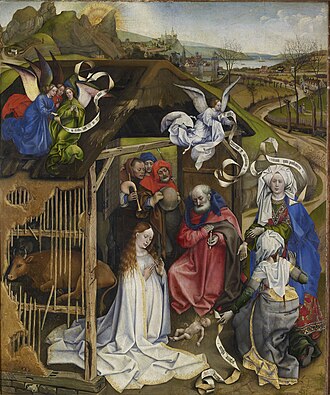
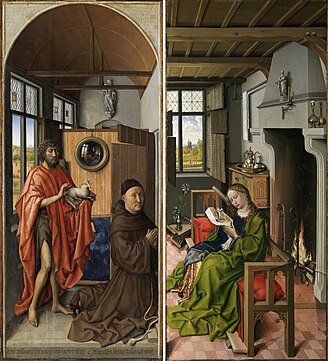
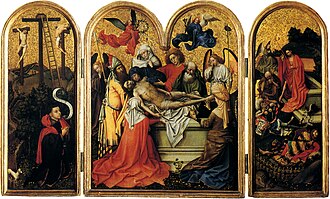
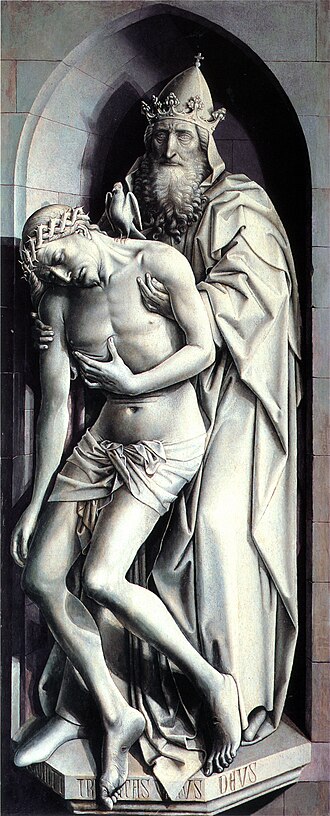
罗伯特·康平(Robert Campin,?—1444年),文艺复兴时期欧洲佛兰德艺术家。与扬·范艾克同是早期尼德兰画派的主要奠基人。其作品透视夸张,细节逼真精致,世俗化倾向明显。由于其职业特性,他多年为人所误读,他长于个人肖像画创作也擅长祭坛画的绘制。代表作《麦洛德祭坛画》等。
摘自维基百科「罗伯特·康平」,按 CC BY-SA 4.0 使用,繁体已转简体,去掉了参考文献、外部链接等尾部小节和表格,其余文字未作改动。
中文条目比较短,展开看英文维基百科的条目(英文原文)
Robert Campin (c. 1378 – 26 April 1444), now usually identified with the Master of Flémalle (earlier the Master of the Merode Triptych before the discovery of three other similar panels), was a master painter who, along with Jan van Eyck, initiated the development of early Netherlandish painting, a key development in the early Northern Renaissance.
While the existence of a highly successful painter called Robert Campin is relatively well documented for the period, no works can be certainly identified as by him through a signature or contemporary documentation. A group of paintings, none dated, have been long attributed to him, and a further group were once attributed to an unknown "Master of Flémalle". It is now usually thought that both groupings are by Campin, but this has been a matter of some controversy for decades.
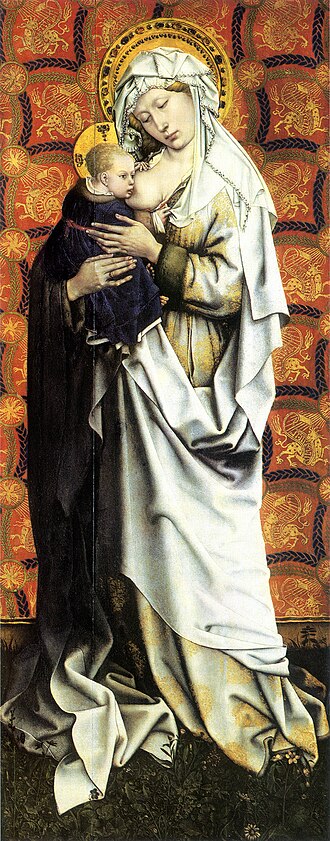
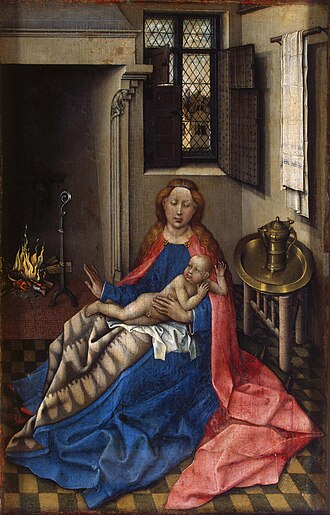
A corpus of work is attached to the unidentified "Master of Flémalle," so named in the 19th century after three religious panels said to have come from a monastery in Flémalle. They are each assumed to be wings of triptychs or polyptychs, and are the Virgin and Child with a Firescreen now in London, a panel fragment with the Thief on the Cross in Frankfurt, and the Brussels version of the Mérode Altarpiece.
Campin was active by 1406 as a master painter in Tournai, in today's Belgium, and became that city's leading painter for 30 years. He had attained citizenship by 1410. His fame had spread enough by 1419 that he led a large and profitable workshop. He had an extra-marital affair with a woman named Leurence Pol, which led to his imprisonment. Campin, however, was able to maintain his public standing and workshop until his death in 1444.
The early Campin panels show the influence of the International Gothic artists the Limbourg brothers (1385–1416) and Melchior Broederlam (c. 1350 – c.1409), but display a more realistic observation than any earlier artists, achieved through innovations in the use of oil paints. He was successful in his lifetime, and the recipient of a number of civic commissions. Campin taught both Rogier van der Weyden, named in these early records as Rogelet de la Pasture, a French version of his name) and Jacques Daret. Campin was a contemporary of Jan van Eyck, and they are recorded as meeting in 1427. Campin's best known work is the Mérode Altarpiece of c. 1425–28.
Life
Campin first appears as settled in Tournai from the archives of 1405–06, as a free master of the guild of goldsmiths and painters. There has been speculation about his origin and birthplace, although he is sometimes listed as having been born in Valenciennes. In 1408 he had purchased the house that he had been leasing since 1406 near the Tournai Cathedral. In 1410, he bought full citizenship. Records show a large number of commissions from individuals and guilds, as well as from ecclesiastical and civic authorities. Campin owned several houses, purchased city bonds and invested in mortgages.
Between 1423 and 1429, the city government was dominated by the guilds. Campin was the deputy dean of the guild of goldsmiths and painters in 1423–24 and 1425. In 1427 he represented the guild on the city council.
Between 1426 and 1428, during his time at the guild, Campin employed four different apprentices Rogelet de le Pasture, Haquin de Blandain, Jaquelotte Daret, Willemet. After restoration of the oligarchy of full citizens, the leaders of the guild regime, including Robert Campin, were brought to court. Campin was ordered to make a pilgrimage to Saint-Gilles and pay the fine.
Campin was married to Ysabel de Stocquain (Elisabeth van Stokkem). The couple was childless. He had an affair with Laurence Polette, for which he was prosecuted in 1432 and sentenced to banishment for a year. Margaret of Burgundy, wife of the Count of Holland and sister of John the Fearless, Duke of Burgundy, intervened on his behalf, and the penalty was reduced to a fine.
A short time after the verdict Campin's apprentices Rogier van der Weyden and Jacques Daret were accepted as masters into the guild of painters. However, the dated Werl Altarpiece (1438) shows he continued to work (the two outer wings are in the Prado but the main panel is lost). He died in his adopted city of Tournai in 1444.
节选,摘自英文维基百科「Robert Campin」,按 CC BY-SA 4.0 使用。
师承与影响
同属「早期尼德兰油画」的画家
流派页 ›同时代的南尼德兰画家
流派与收藏
作品(14)