艺廊
资料卡
- 别名
- Charles Andre van Loo
- 出生
- 1705 年
- 出生地
- 尼斯
- 去世
- 1765 年
- 逝世地
- 巴黎
- 国籍
- 法国
- 职业
- 画家、视觉艺术家
- 流派
- 洛可可
- 老师
- 约瑟夫·阿韦德、Jean-Baptiste van Loo、Benedetto Luti、Pierre Le Gros the Younger
- 学生
- Johann Heinrich Tischbein、亚历山大·库哈斯基、加布里耶·弗朗索瓦·都尔杨、伯恩哈德·罗德、Louis-Jean-François Lagrenée、菲利普·詹姆斯·德·路德堡 等 9 项
- 代表作
- Louis XV, King of France (1710-1774)、Marie Leszczyńska, Queen of France (1703-1768)
- 所属团体
- 王家绘画与雕塑学院
- 获奖
- 圣米迦勒勋章、罗马绘画一等奖
- 父亲
- Louis-Abraham van Loo
资料来自 Wikidata Q686597(CC0)。
生平与创作
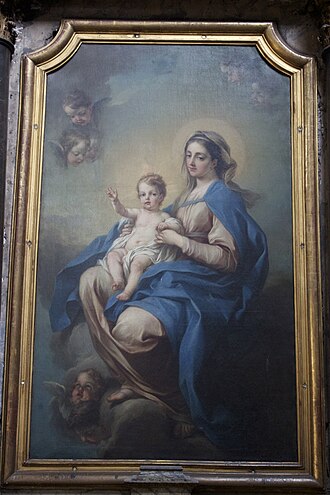
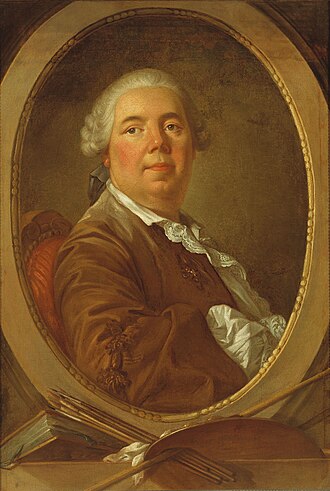
Carle or Charles-André van Loo (French pronunciation: [ʃaʁl ɑ̃dʁe vɑ̃ lo]; 15 February 1705 – 15 July 1765) was a French painter, son of the painter Louis-Abraham van Loo, a younger brother of Jean-Baptiste van Loo and grandson of Jacob van Loo. He was the most famous member of a successful dynasty of painters of Dutch origin. His oeuvre includes every category: religion, history painting, mythology, portraiture, allegory, and genre scenes.
Life
He was born in Nice, then part of the Savoyard state. Van Loo followed his brother Jean-Baptiste to Turin, and then to Rome in 1712, where he studied under Benedetto Luti and the sculptor Pierre Le Gros. After leaving Italy in 1723, he worked in Paris, studied at the Académie royale de peinture et de sculpture, where he gained first prize for drawing in 1723, and received the first prize for historical painting in 1727—as did his future rival François Boucher. In 1724 he won the Prix de Rome.
After again visiting Turin in 1727, he was employed by King Victor Amadeus II of Sardinia, for whom he painted a series of subjects illustrative of Torquato Tasso. In 1734 he settled in Paris, and in 1735 became a member of the Académie royale de peinture et de sculpture and rose rapidly in the hierarchy of the academy. Madame de Pompadour and the French court took the artist under their patronage. He was decorated with the Order of Saint Michael and named First Painter to King Louis XV in 1762. He was a most successful court painter but his portraits as well as history paintings also enjoyed an enormous success throughout all Europe. He died in Paris on 15 July 1765.
Work
By his simplicity of style and correctness of design, the result of his study of the great Italian masters, he did much to purify the modern French school; but the praise that was later lavished upon his productions now appears undue and excessive. His patrons included members of the court, the Gobelins Manufactory, private individuals, and the church. In the ensuing centuries, van Loo's critical fortune has plummeted, although his ability remains admirable, and the quality and variety of his work command respect. His Marriage of the Virgin is preserved in the Louvre.
摘自英文维基百科「Charles-André van Loo」(暂时没有中文条目,下面是英文原文),按 CC BY-SA 4.0 使用,去掉了参考文献、外部链接等尾部小节和表格,其余文字未作改动。
师承与影响
同属「Rococo painting」的画家
流派页 ›同时代的法国画家
流派与收藏
作品(14)