 艺廊
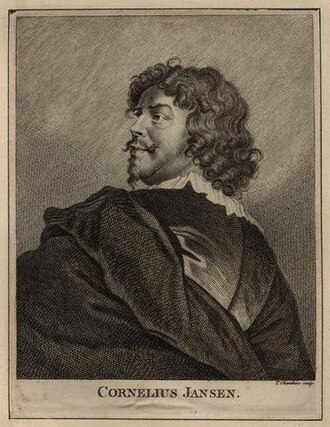
资料卡
- 出生
- 1593 年
- 出生地
- 伦敦
- 去世
- 1661 年
- 逝世地
- 乌得勒支
- 国籍
- 英格兰、英国、荷兰共和国
- 职业
- 画家、视觉艺术家
- 代表作
- Portrait of John Beck and his five children、Portrait of Joan Pietersz Reael (1625-59)、Portrait of Johan van Someren (1622-76)
资料来自 Wikidata Q636113(CC0)。
生平与创作
Cornelis Janssens (born Cornelis Janssens van Ceulen, Dutch: [kɔrˈneːlɪ ˈɕɑnsəns fɑŋ ˈkøːlə(n)]; bapt. 14 October 1593 – bur. 5 August 1661) was an Anglo-Dutch painter of portraits. Born of Dutch or Flemish parents who fled to London from Antwerp to escape religious persecution, Cornelis Janssens van Ceulen probably trained in the northern Netherlands. Around 1618 he established himself as a portrait painter in London. His signed or monogrammed portraits number several hundred; he is the first English-born painter known to have made so many. He was active in England, from at least 1618 to 1643, when he moved to Middelburg in the Netherlands to escape the English Civil War. Between 1646 and 1652 he lived in Amsterdam, before settling in Utrecht, where he died.
Janssens painted many portraits of emerging new English gentry. His early portraits were panel paintings with "fictive" oval frames. His works can be found in major collections in the UK and overseas as well as in private collections in stately homes in Britain.
He was an accomplished portrait painter, but lacked the flair of a master such as Anthony van Dyck. His style varied considerably over his career, and he was able to assimilate new influences into his own style without any discordant effect. He was particularly accurate and detailed in his depiction of clothing. He was one of the few artists in England at this time who consistently signed and dated their work.
Family life
Janssens was born to Dutch or Flemish parents in London – his father had been a religious refugee from Antwerp, and his paternal grandfather had come from Cologne. He was baptised at the Dutch Church at Austin Friars much used by the Netherlandish community in London. He was the son of Johanna le Grand and Cornelis Janssens. He may have been trained in the Netherlands, possibly under Michiel Jansz. van Mierevelt. He was certainly influenced by other artists from the Netherlands, and his early works follow the design and mood of Dutch painters.
He had returned to England by 1618 when he was a witness at the baptism of his nephew, Theodore Russell – Johnson' sister was married to Nicholas Russell of Bruges. He was active in England, from then until 1643. In the 1620s, he lived and had his studio in Blackfriars, London, as did Anthony van Dyck and Peter Oliver; it was within the boundaries of the City of London, but was a liberty and so avoided the monopoly in the City of members of the London painters' Guild. He married Elizabeth Beke of Colchester on 16 July 1622 at the Dutch church in London. Their son James (who presumably died young) was baptised on 30 September 1623 at St Anne's Church. Another son Cornelis Janssens, junior who also became a painter, was baptised on 15 August 1634.
Janssens wished to be regarded as an English gentleman, registering his pedigree with the College of Arms. His arms were three gold parrots on a gold background, and had a crest of a silver Catherine wheel with two parrot wings behind it. Apparently winged crests are common in German heraldry which may show the arms previously used by the family.
Janssens moved to Canterbury in the mid-1630s, living with Sir Arnold Braems, a Flemish merchant, and continued to live in England until after the outbreak of the English Civil War, but in October 1643, apparently at the insistence of his wife, he moved to Middelburg, joining the Guild of Saint Luke there. He was given parliamentary permission to travel " ... and to cary with him such pictures and colours, bedding, household stuff, pewter, and brass as belongs to himself". Between 1646 and 1652 he lived in Amsterdam, before settling in Utrecht, where he was buried.
Portraiture
Janssens' first dated work is from 1617, and may be of a Dutch subject; 1619 marks the beginning of his English portraits, which were initially heads only, although he later painted full-length and group portraits.
For painting a portrait, Janssens liked to charge £5 compared with a more typical figure of 10s – 20s. However, this was not as expensive as better known artists such as van Dyck or Peter Lely. Karen Hearn's ODNB entry for Janssens notes that "in 1638 Sir Thomas Pelham of Halland House, Sussex, paid £4 for his portrait by Janssens" (referencing an account book among the Pelham family papers, BL, Add. MS 33145, fol. 107).
There are hundreds of portraits of the emerging new gentry by Janssens, including Lady Rose MacDonnell of Antrim. "Janssens’ art was best suited to the relative intimacy of the bust length portrait in which, with a certain detachment, he captured the reticence of the English landed gentry and minor aristocracy". One of his earliest surviving portraits is of Susanna Temple, grandmother of Sarah, Duchess of Marlborough (Tate). This portrait was subsequently engraved by Robert White towards the end of the seventeenth century. A copy of the engraving was among the prints owned by Samuel Pepys which subsequently passed to Magdalene College, Cambridge.
His royal portraits include Charles I as well as Charles II and James II, painted as children, both of which are in the National Portrait Gallery, London. He collaborated with Gerard Houckgeest on a portrait of Charles I's wife, Queen Henrietta Maria.
After his move to the Netherlands, he continued to produce portraits of English clients – both exiled Royalists, and clients still living in England.
Studio
Janssens’ studio in the 1620s was in St Anne's, Blackfriars, London. The size of Janssens’ studio is not known, but surviving portraits such as the portrait erroneously inscribed Countess of Arundel and that of Sir Alexander Temple (both below) help reconstruct the painting process. It is likely that Janssens did not paint the complete portraits himself. The wet-over-dry paint layering of the costumes (see 'Technique' below) and the fictive ovals allowed contributions from others in the studio, as did the demand for additional versions.
Patronage
His patrons came from the gentry, but were not from the highest levels in society. His sitters were Dutch immigrants, gentlemen and courtiers. During the first few years of his career, a network of patronage by five families enabled Janssens to establish his reputation as a painter on the national stage.……
原文较长,这里只摘了前面一部分,摘自英文维基百科「Cornelius Johnson (artist)」(暂时没有中文条目,下面是英文原文),按 CC BY-SA 4.0 使用,去掉了参考文献、外部链接等尾部小节和表格,其余文字未作改动。


