艺廊
资料卡
- 出生
- 1860 年
- 出生地
- 斯莱恩
- 去世
- 1939 年
- 逝世地
- 曼彻斯特
- 安葬地
- 大曼彻斯特郡
- 国籍
- 爱尔兰
- 职业
- 画家、雕塑家
- 学生
- John Ashton Floyd
资料来自 Wikidata Q6225483(CC0)。
生平与创作
John Cassidy (1 January 1860 – 19 July 1939) was an Irish sculptor and painter who worked in Manchester, England, and created many public sculptures.
Life
Cassidy was born in the townland of Littlewood Commons, Slane, County Meath, Ireland, on 1 January 1860. He moved to Dublin at the age of 20 to find work. There he attended art classes at night and won a scholarship to study in Milan, Italy. After two years, he moved to Manchester, England, where he lived for the rest of his life. He studied at the Manchester School of Art in 1883 and taught there in 1887.
He created many public sculptures, especially war memorials, and exhibited at the Royal Academy, the Royal Hibernian Academy and in Manchester City Art Gallery. He was for a time assisted in his studios by John Ashton Floyd, a local sculptor. For most of his career, his studio was at Lincoln Grove in Chorlton-on-Medlock.
Works
The body of Cassidy's work consisted mainly of memorials and statues.
In 1894, the philanthropist Enriqueta Rylands commissioned a statue from Cassidy of her late husband, the textile manufacturer John Rylands. It was placed in the reading room of the John Rylands Library in Manchester, which she founded in her husband's memory. Supporters of the library later commissioned Cassidy to sculpt a statue of Enriqueta herself, which was unveiled in 1907. Both statues still stand today at either end of the library reading room, now part of the Manchester University Library. Also within the library is a sculpted group of three figures representing Theology inspiring Science and Art (1898).
The Manchester Corporation commissioned Cassidy in 1896 to design a large ornamental fountain for Albert Square, Manchester to mark the Diamond Jubilee of Queen Victoria. The hexagonal Jubilee Fountain stood in the square until the 1920s, when it was moved to Heaton Park. In 1997 during renovations and pedestrianisation of Albert Square the fountain was restored to its original location.
Another noted Manchester work is a 1907 bronze sculpture entitled Adrift, depicting a family clinging to a raft in a stormy sea, its style showing the influence of the New Sculpture movement. It was exhibited at the New Gallery in London and then gifted by the Manchester industrialist and art collector James Gresham to the Manchester Corporation, who used it as the centrepiece of the new ornamental Piccadilly Gardens, laid out c.1930. In 1953 it was replaced by a fountain and relocated. Adrift now stands in front of the Manchester Central Library in St Peter's Square.
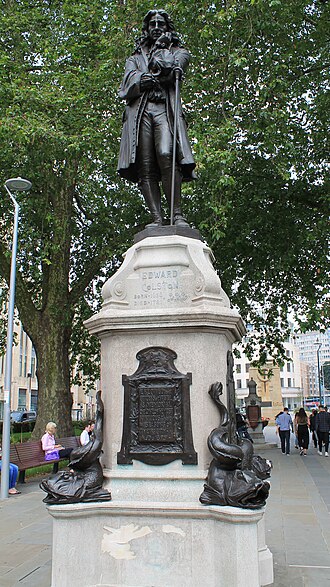
A public monument in Bristol commissioned in 1895 from Cassidy rose to prominence in 2020. Cassidy's statue of Edward Colston was erected in the area now known as The Centre to celebrate the philanthropy of the merchant Edward Colston, but had come to be considered controversial due to Colston's involvement in the Atlantic slave trade. On 7 June 2020, the Colston statue was pulled from its plinth by Black Lives Matter protestors and pushed into Bristol Harbour. From June 2021 the statue was exhibited at the M Shed museum in Bristol, in damaged and disfigured condition.
Many of Cassidy's surviving works remain in the Manchester district, while other smaller works are held in private collections.
Selected works
Works by John Cassidy include:
Adrift, Manchester
Clayton-le-Moors war memorial
Duthie Monument, Duthie Park, Aberdeen
John Kay memorial, Bury, Greater Manchester
Jubilee Fountain, Albert Square, Manchester
Sir Benjamin Alfred Dobson statue, Bolton
Statue of Edward Colston, Bristol
Statue of Edward VII, Manchester
Statue of Enriqueta Rylands, John Rylands Library, Manchester
Statue of John Rylands, John Rylands Library, Manchester
Bust of Harry Houdini
In the aftermath of World War I, Cassidy was commissioned to sculpt a number of war memorials for towns around Britain, including memorials in Eccles, Heaton Chapel/Heaton Moor, Skipton, Stourbridge and Colwyn Bay.
Death and legacy
At the end of his life, Cassidy was living in Fallowfield in south Manchester, at 10 Albion Road. Suffering from ill health, he was taken to St Joseph's Hospital in Whalley Range. While in hospital, Cassidy continued to sculpt and was working on a bust of Pope Pius XII when he died there on 19 July 1939, aged 79. He was buried in the Roman Catholic section of Manchester's Southern Cemetery. His headstone bears the inscription, "His hands fashioned the beauty he saw".
Many of his public sculptures remain on view in towns and cities around the United Kingdom today. A 1900 portrait of John Cassidy by Reginald Barber is in the collection of Manchester Art Gallery.
摘自英文维基百科「John Cassidy (artist)」(暂时没有中文条目,下面是英文原文),按 CC BY-SA 4.0 使用,去掉了参考文献、外部链接等尾部小节和表格,其余文字未作改动。