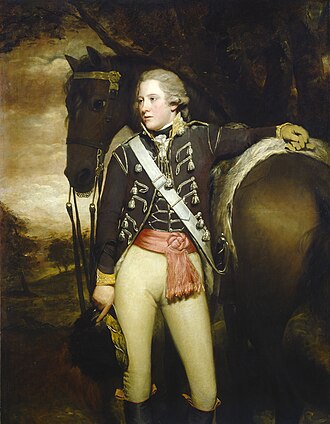
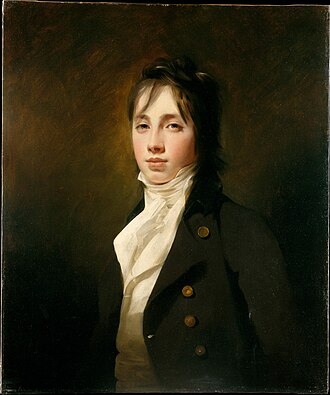
艺廊
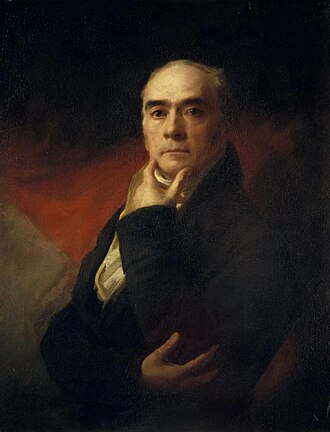
资料卡
- 出生
- 1756 年
- 出生地
- Stockbridge
- 去世
- 1823 年
- 逝世地
- 爱丁堡
- 国籍
- 大不列颠王国、大不列颠及爱尔兰联合王国
- 职业
- 画家、肖像艺术家
- 流派
- 浪漫主义
- 代表作
- 滑冰的牧师、E. Finley, Esquire
- 就读
- 乔治·赫里奥特学校
- 所属团体
- 爱丁堡皇家学会、皇家艺术学院、Edinburgh Cape Club
- 获奖
- 下级勋位爵士、爱丁堡皇家学会会员
- 配偶
- Anne Edgar
资料来自 Wikidata Q561916(CC0)。
生平与创作
亨利·雷伯恩爵士 FRSE RA (英语:Sir Henry Raeburn /ˈreɪbərn/;1756年3月4日—1823年7月8日)是一名苏格兰肖像画画家,是乔治四世的御用画家。
生平
他出生于苏格兰爱丁堡斯托克布里奇(Stockbridge),小时候就有绘画的爱好。经约书亚·雷诺兹推荐到意大利采风,1787年返回爱丁堡之后开始自己的事业,为当时的许多苏格兰名流绘制过肖像。1822年8月29日在乔治四世访问苏格兰时获封骑士,并被任命为御用画师(limner)。次年,他在爱丁堡去世。
摘自维基百科「亨利·雷伯恩」,按 CC BY-SA 4.0 使用,繁体已转简体,去掉了参考文献、外部链接等尾部小节和表格,其余文字未作改动。
中文条目比较短,展开看英文维基百科的条目(英文原文)
Sir Henry Raeburn (; 4 March 1756 – 8 July 1823) was a Scottish portrait painter. He served as Portrait Painter to King George IV in Scotland.
Biography
Raeburn was born the son of a manufacturer in Stockbridge, on the Water of Leith: a former village now within the city of Edinburgh. He had an older brother, born in 1744, called William Raeburn. His ancestors were believed to have been soldiers, and may have taken the name "Raeburn" from a hill farm in Annandale, held by Sir Walter Scott's family. Orphaned, he was supported by William and placed in Heriot's Hospital, where he received an education. At the age of fifteen he was apprenticed to the goldsmith James Gilliland of Edinburgh, and various pieces of jewellery, mourning rings and the like, adorned with minute drawings on ivory by his hand, still exist. When the medical student Charles Darwin died in 1778, his friend and professor Andrew Duncan took a lock of his student's hair to the jeweller whose apprentice, Raeburn, made a memorial locket.
Soon he took to the production of carefully finished portrait miniatures; meeting with success and patronage, he extended his practice to oil painting, at which he was self-taught. Gilliland watched the progress of his pupil with interest, and introduced him to David Martin, who had been the favourite assistant of Allan Ramsay, and was now the leading portrait painter in Edinburgh. Raeburn was especially aided by the loan of portraits to copy. Soon he had gained sufficient skill to make him decide to devote himself exclusively to painting. George Chalmers (1776; Dunfermline Town Hall) is his earliest known portrait.
In his early twenties, Raeburn was asked to paint the portrait of a young lady he had noticed when he was sketching from nature in the fields. Ann was the daughter of Peter Edgar of Bridgelands, and widow of Count James Leslie of Deanhaugh. Fascinated by the handsome and intellectual young artist, she became his wife within a month, bringing him an ample fortune. The acquisition of wealth did not affect his enthusiasm or his industry, but spurred him on to acquire a thorough knowledge of his craft. It was usual for artists to visit Italy, and Raeburn set off with his wife. In London he was kindly received by Sir Joshua Reynolds, the president of the Royal Academy, who advised him on what to study in Rome, especially recommending the works of Michelangelo, and gave Raeburn letters of introduction for Italy. In Rome he met his fellow Scot Gavin Hamilton, Pompeo Batoni and James Byres, an antique dealer whose advice proved particularly useful, especially the recommendation that "he should never copy an object from memory, but, from the principal figure to the minutest accessory, have it placed before him." After two years of study in Italy he returned to Edinburgh in 1787, and began a successful career as a portrait painter. In that year he executed a seated portrait of the 2nd Lord Arniston, Lord President of the Court of Session.
Examples of his earlier portraiture include a bust of Mrs Johnstone of Baldovie and a three-quarter-length of Dr James Hutton: works which, if somewhat timid and tentative in handling and not as confident as his later work, nevertheless have delicacy and character. The portraits of John Clerk, Lord Eldin, and of Principal Hill of St Andrews belong to a later period. Raeburn was fortunate in the time in which he practised portraiture. Sir Walter Scott, Hugh Blair, Henry Mackenzie, Lord Woodhouselee, William Robertson, John Home, Robert Fergusson, and Dugald Stewart were resident in Edinburgh, and were all painted by Raeburn. Mature works include his own portrait and that of Sir Henry Moncrieff Wellwood, a bust of Dr Wardrop of Torbane Hill, two full-lengths of Adam Rolland of Gask, the remarkable paintings of Lord Newton and Dr Alexander Adam in the National Gallery of Scotland, and that of William Macdonald of St Martin's. Apart from himself, Raeburn painted only two artists, one of whom was Sir Francis Leggatt Chantrey, the most important and famous British sculptor of the first half of the 19th century. It has recently been revealed that Raeburn and Chantrey were close friends and that Raeburn took exceptional care over the execution of his portrait of the sculptor, one of the painter's mature bust-length masterpieces.
节选,摘自英文维基百科「Henry Raeburn」,按 CC BY-SA 4.0 使用。
同属「浪漫主义」的画家
流派页 ›同时代的大不列颠王国画家
流派与收藏
作品(9)