艺廊

资料卡
- 本名
- Alexandre Georges Henri Regnault
- 出生
- 1843 年
- 出生地
- 原巴黎第十二区
- 去世
- 1871 年
- 逝世地
- Buzenval
- 安葬地
- 蒙帕纳斯公墓
- 国籍
- 法国
- 职业
- 画家、视觉艺术家
- 领域
- 绘画、视觉艺术
- 流派
- 东方主义
- 老师
- 亚历山大·卡巴内尔、Louis Lamothe
- 代表作
- Spanish woman
- 就读
- 国立高等美术学院、罗马法兰西学院、亨利四世中学
- 获奖
- 罗马大奖
- 父亲
- 亨利·维克托·勒尼奥
资料来自 Wikidata Q553571(CC0)。
生平与创作
Alexandre Georges Henri Regnault (French pronunciation: [alɛksɑ̃dʁ ʒɔʁʒ ɑ̃ʁi ʁəɲo]; 31 October 1843 – 19 January 1871) was a French painter.
Biography
Regnault was born in Paris, the son of Henri Victor Regnault. On leaving school he successively entered the studios of Antoine Montfort, Louis Lamothe and Alexandre Cabanel, was beaten for the Prix de Rome (1863) by Joseph Layraud and Xaiver Monchablon, and in 1864 exhibited two unremarkable portraits at the Paris Salon. In 1866, however, he carried off the Prix de Rome with a work of unusual force and distinction Thetis bringing the Arms forged by Vulcan to Achilles (École de Beaux-Arts).
The past in Italy did not touch him, but his illustrations to Wey's Rome show how observant he was of actual life and manners; even his Automedon (School of Fine Arts), executed in obedience to Academical regulations, was but a lively recollection of a carnival horse-race. At Rome, moreover, Regnault came into contact with the modern Hispano-Italian school, a school highly materialistic and inclined to regard even the human subject only as one amongst many sources of visual amusement. The vital, if narrow, energy of this school told on Regnault with ever-increasing force during the few remaining years of his life.
In 1868 he had sent to the Salon a life-size portrait of a lady in which he had made one of the first attempts to render the actual character of fashionable modern life. While making a tour in Spain, he saw General Juan Prim pass at the head of his troops, and received that lively image of a military demagogue which he afterwards put on canvas, somewhat to the displeasure of his subject. But this work made an appeal to the imagination of the public, while all the later productions of Regnault were addressed exclusively to the eye.
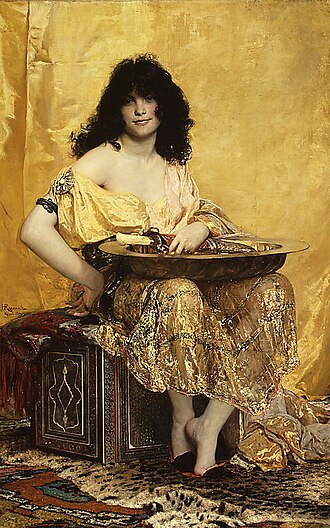
After a further trip to North Africa, abridged by the necessities of his position as a pensioner of the school of Rome, he painted Judith, then, in 1870, Salomé, and, as a work due from the Roman school, dispatched from Tangier the large canvas, Summary Execution under the Moorish Kings of Granada. The Franco-Prussian War arose, and found Regnault at the Battle of Buzenval, where he was killed on 19 January 1871.
His friend, the composer Camille Saint-Saëns dedicated his Marche héroïque (1871) to Regnault's memory. The sculptor Henri Chapu erected a monument to him in the courtyard of the École des Beaux-Arts in 1872. Jean-Louis-Ernest Meissonier painted him in the centre of his Le siège de Paris as the soldier collapsed against the personification of Paris.
Marc Gotlieb's The Deaths of Henri Regnault (University of Chicago Press, 2016) documents the vicissitudes of Regnault's legacy as artist and national symbol.
摘自英文维基百科「Henri Regnault」(暂时没有中文条目,下面是英文原文),按 CC BY-SA 4.0 使用,去掉了参考文献、外部链接等尾部小节和表格,其余文字未作改动。