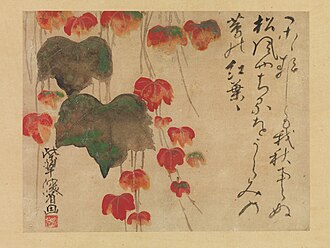
艺廊
资料卡
- 出生
- 1663 年
- 出生地
- 京都市
- 去世
- 1743 年
- 逝世地
- 东京
- 国籍
- 日本
- 职业
- 画家、制陶人、陶艺家
资料来自 Wikidata Q534279(CC0)。
生平与创作
尾形干山(日语:尾形 干山,1663年—1743年7月22日),京都人,日本江户时代的陶艺家。尾形光琳的弟弟。
摘自维基百科「尾形干山」,按 CC BY-SA 4.0 使用,繁体已转简体,去掉了参考文献、外部链接等尾部小节和表格,其余文字未作改动。
中文条目比较短,展开看英文维基百科的条目(英文原文)
Ogata Kenzan (尾形 乾山; 1663–1743), originally Ogata Shinsei (尾形 深省), was an Edo period Japanese potter, painter, and calligrapher. He was also known by the pseudonyms Shisui, Shōkosai, Shuseidō, Tōin, and Shinshō. He is associated with Kyō ware and Kiyomizu ware.
Biography
Ogata Kenzan was the third son born into a rich kimono merchant family in Kyoto. The family's shop, the Kariganeya, was patronized by Oeyo, the wife of Tokugawa Hidetada, and Tokugawa Masako. His father was Ogata Sōken (1621–1687), a calligrapher and patron of Noh. His older brother was the painter Ogata Kōrin (1658–1716). Following his father's death, the eldest of the Ogata brothers took over the Kariganeya, allowing Kenzan and Kōrin to enjoy their inheritance and pursue pottery and painting. From a young age, Ogata received lessons in pottery from Koho and Rakuichi, grandchildren of Hon'ami Kōetsu.
In 1689, Ogata established Shuseidō hall south of Ninna-ji. Ogata studied with the potter Nonomura Ninsei whose Omuru kiln was located at the front gate of Ninna-ji. In 1699, Kugyō Nijō Tsunahira provided Ogata with a mountain villa in Ukyō-ku, Kyoto where Kenzan established his own kiln. In 1731, Kenzan was invited by Cloistered Imperial Prince Rinnojinomiya Kinkan to move to Edo where he spent the remainder of his life. He died at the age of 81.
Ogata produced a distinctive style of freely brushed grasses, blossoms, and birds as decorative motifs for pottery. His pieces were noted for their perfect relation between design and shape. He often collaborated on the decoration of pottery with his older brother, Ogata Kōrin, after whom the style known as Rinpa was named.
摘自英文维基百科「Ogata Kenzan」,按 CC BY-SA 4.0 使用。