艺廊
资料卡
- 出生
- 1764 年
- 出生地
- 柏林
- 去世
- 1850 年
- 逝世地
- 柏林
- 安葬地
- 多荣帖恩小镇墓园
- 国籍
- 普鲁士王国
- 职业
- 插画家、画家、雕塑家、平面设计师、caricaturist、版画家 等 8 项
- 领域
- 视觉艺术
- 老师
- 吉恩·皮尔·安托万·塔萨特
- 学生
- 理查德·卢卡、Christian Friedrich Tieck、Angelica Facius、威廉·冯·沙多、Reinhold Begas、劳赫 等 9 项
- 所属团体
- 瑞典皇家美术学院、Königlich Sächsischer Altertumsverein
- 获奖
- 北极星勋章、Pour le Mérite for Sciences and Arts order
- 父亲
- Gottfried Schadow
- 配偶
- Henriette Schadow
资料来自 Wikidata Q51989(CC0)。
生平与创作
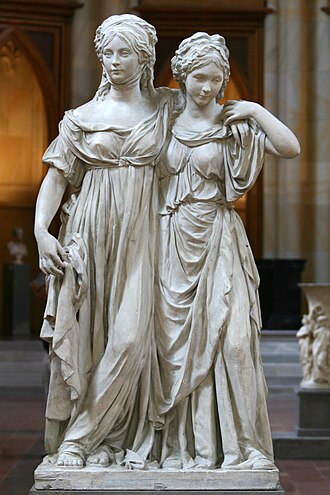
约翰·哥特弗里德·沙都(Johann Gottfried Schadow,1764年5月20日—1850年1月27日),德国雕塑家。他创作的最著名作品之一是Prinzessinengruppe,现藏于柏林旧国家画廊。
生平
约翰·哥特弗里德·沙都出生于柏林,他的父亲是一位贫穷的裁缝,而其艺术启蒙老师是吉恩·皮尔·安托万·塔萨特
摘自维基百科「约翰·哥特弗里德·沙都」,按 CC BY-SA 4.0 使用,繁体已转简体,去掉了参考文献、外部链接等尾部小节和表格,其余文字未作改动。
中文条目比较短,展开看英文维基百科的条目(英文原文)
Johann Gottfried Schadow (20 May 1764 – 27 January 1850) was a German Prussian sculptor.
His most iconic work is the chariot on top of the Brandenburg Gate in Berlin.
Biography
Schadow was born in Berlin, where his father was a poor tailor.
He trained as a sculptor under Antoine Tassaert, who was patronized by Frederick the Great. Taessert offered his daughter in marriage, but the pupil preferred to elope with a Jewish girl, Marianne Devidel in Rome and Taessert not only condoned the offense but furnished money for their stay in Italy. After he married Devidel in Rome he also won the sculptors prize from the Accademia di San Luca in 1786. Having been influenced by the sculptor Antonio Canova during his stay in Rome he returned to Berlin in 1788 to succeed Tassaert as sculptor to the court and secretary to the Prussian Academy of Arts and Royal Porcelain Factory. Upon his return, his first work was the tomb of the son of the Prussian King Friedrich Wilhelm II, Alexander von der Mark. Over half a century he produced upwards of two hundred works, varied in style as in subjects.
Among his ambitious efforts are Frederick the Great in Stettin, Blücher in Rostock and Luther in Wittenberg. His portrait statues of Frederick the Great with the dogs and the Princess Monument Louise and her sister Frederica with the princesses Louise and Federica became very popular. The second one was copied many times illegally which lead to a temporary dispute between his gypsum modeler Beyer and the sculptor in September 1795. His busts, of which there are more than one hundred, include seventeen colossal heads in the Walhalla, Ratisbon; Goethe, Wieland, and Fichte were modelled from life.
Of church monuments and memorial works thirty are enumerated; yet Schadow hardly ranks among Christian sculptors. He is claimed by classicists and idealists: the quadriga on the Brandenburger Tor and the allegorical frieze on the facade of the Royal Mint, both in Berlin, are judged among the happiest studies from the antique. Schadow, as director of the Berlin Academy, had great influence. He wrote on the proportions of the human figure, on national physiognomy, etc.; and many volumes by himself and others describe and illustrate his method and his work.
His interest in physiognomy is documented by the drawing he made of Harry Maitey, the first Hawaiian in Prussia.
Today, some of his sculptures and busts are displayed in the Friedrichswerdersche Kirche and the Alte Nationalgalerie in Berlin.
Schadow developed a friendship with Johann Wolfgang von Goethe when at first Goethe's son visited Schadow in Weimar. Schadow created 12 bronze medals of Goethe. One such medal is in the property of the British Museum.
He died in Berlin in 1850. His sons Rudolph and Friedrich Wilhelm were notable for sculpture and painting, respectively. He was the grandfather of admiral Felix von Bendemann of the German Imperial Navy.
Family
He was uncle to the sculptor Emil Wolff.