 艺廊
资料卡
- 本名
- Agustín Querol Subirats
- 出生
- 1860 年
- 出生地
- 托尔托萨
- 去世
- 1909 年
- 逝世地
- 马德里
- 安葬地
- San Justo Cemetery
- 国籍
- 西班牙
- 职业
- 政治人物、雕塑家、币章雕刻家
- 学生
- Jacinto Higueras Fuentes
- 代表作
- Monument to the Sieges of Zaragoza、Panteón Guirao、Monument to Méndez Núñez, Vigo
- 就读
- Real Academia de España en Roma
- 获奖
- Grand cross of the Civil Order of Alfonso XII
资料来自 Wikidata Q4694649(CC0)。
生平与创作
Agustí Querol i Subirats (or Agustín Querol y Subirats) (May 17, 1860 – December 14, 1909) was a Spanish sculptor, born in Tortosa, Catalonia, Spain.
Life
Born to a poor family, the son of a baker, Querol was educated under Ramon Cerveto Bestraten (1829–1906). At the age of 18, he left his job at his father's bakery and moved to Barcelona, where he worked as an apprentice at the studios of Domingo Talarn and of the Vallmitjana Brothers. He also attended sculpture classes at the Escola Provincial de Belles Arts (called colloquially “la Llotja”). He studied dissection and anatomy at the Hospital de la Santa Creu in Barcelona, then won a scholarship to study in Rome.
Based in Madrid from 1890, he was responsible for many monuments, sculptures, and project proposals through much of the Spanish-speaking world. Querol's work is characterized by the same romantic style, fluid modeling, wealth of detail and technical skill as his French fin de siècle contemporaries like Jules Dalou, but Querol's work is even more dynamic and profuse. The pediment for the Biblioteca Nacional de España, for instance, is crowded with 19 separate figures. All of his major designs are equally busy.
Querol ran a relatively large studio. Among the apprentices in his studio were Lorenzo Coullaut Valera and Jacinto Higueras. Querol also worked as a businessman, dealing in Carrara marble; was involved in art expositions; wrote literary pieces under the pseudonym El Plutarco del Pueblo, the "People's Plutarch"; served as vice-director of the Museo de Arte Moderno de Madrid (1892–1895) and a Conservative deputy to the Cortes (for Roquetes); and was a man about town.
Querol died in Madrid, and is buried in San Justo in Madrid.
He left unfinished monuments in Tortosa, Buenos Aires, Guayaquil, and Montevideo, which were later completed after his death. One example is the Monument De los Españoles in Buenos Aires. The elaborate sculpture, representing a statue of Liberty on a tower, with an extensive frieze at the base, all of it set in a pool with fountains, surrounded by monumental bronze figures dedicated to the Constitution of Argentina and the country's regions, was designed before Querol's death. It was begun in 1910, assigned to a replacement sculptor Cipriano Folgueras who then died in 1911, and further delayed with the tragic 1916 loss of the trans-Atlantic steamer Prince of Asturias, which sank with the loss of 457 lives and a cargo of finished bronze and marble sculptures. The monument was finally completed in 1927.
Works
Figures of Sagunto or Suicides of Sagunto, 1888, originally placed in the Plaza San Martin, Buenos Aires, now shown at the Buenos Aires Botanical Garden
Finial figure of Spain with lion, two other figures and a full sculpted pediment, topping the Biblioteca Nacional de España, Madrid, 1892–1903
The mausoleum Guirao Pantheon, San Isidro Cemetery, Madrid, 1908-1911 (finished posthumously)
Monument to explorers Adelantado Legazpi and Urdaneta, 1890s. Originally located in Madrid, then transferred to Manila. The Americans completed the memorial in 1901 by command of General George W. Davis.
Monument to Firemen, Colon Cemetery, Havana, Cuba, 1897
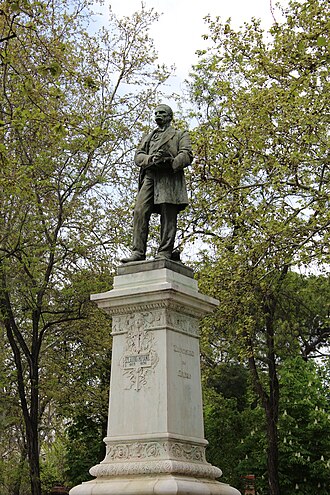
Monument to Claudio Moyano, at the Plaza del Emperador Carlos V, Madrid, 1900
Monument to Francisco de Quevedo, at the Glorieta de Quevedo (originally at the plaza de Alonso Martínez), Madrid, 1902
Monument to the Martyrs of the Plaza of Spain, Zaragoza, 1904
White marble mausoleum of Antonio Cánovas del Castillo, at the Pantheon of Illustrious Men, Madrid, 1906
Statue of Frederic Soler i Hubert (Pitarra Serafí), La Rambla, Barcelona, 1906
Monument to Casilda Iturrizar (the "Widow of Elpalza"), Doña Casilda Iturrizar Park, Bilbao, 1906
Three allegoric sculptural groups La Gloria y los Pegasos, consisting of a middle multi-figural group of Science, Art, and Glory flanked by two rampant pegasus figures, all originally atop the Spanish Ministry of Agriculture, Fisheries and Food, Madrid, 1905. Middle figural group removed to the Glorieta de Cádiz roundabout in 1998
Monument to the Siege of Zaragoza, Zaragoza, 1908
Monument to Segismundo Moret, Cádiz, 1909
Tower monument, frieze, and bronze fountain figures at the Monument De los Españoles, also known as Monument to the Magna Carta, Avenida del Libertador at its intersection with Avenida del Sarmiento, Buenos Aires, Argentina, designed 1909, begun 1910 after Querol's death, finished 1927
four pegasus-with-riders sculptures, installed on the roof of the Palacio de Bellas Artes, Mexico City, originally from the Legislative Palace Monument to the Revolution by architect Émile Bénard
摘自英文维基百科「Agustí Querol Subirats」(暂时没有中文条目,下面是英文原文),按 CC BY-SA 4.0 使用,去掉了参考文献、外部链接等尾部小节和表格,其余文字未作改动。
同时代的西班牙画家
作品(2)
只有资料的作品(1)
- 卡塔麦格纳和四个地区纪念碑1910 年