艺廊
资料卡
- 出生
- 公元前 6 世纪
- 出生地
- 古雅典
- 去世
- 公元前 524 年
- 国籍
- 古雅典
- 职业
- 制陶人、vase painter、black-figure vase painter、Attic vase-painter、ancient Greek potter
- 代表作
- Neck Amphora by Exekias、Grave pinakes by Exekias、Dionysos Cup、Amphora by Exekias with Ajax and Achilles、Apotheosis of Heracles
资料来自 Wikidata Q358541(CC0)。
生平与创作
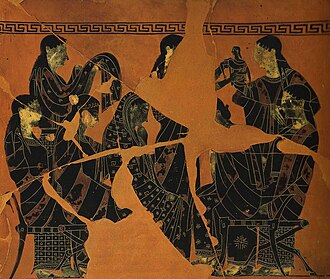
埃克塞基亚斯(英语:Exekias),约活动于公元前6世纪前后。古希腊阿提卡最优秀的黑绘陶瓶画师,公元前550年至公元前530年为其创作期,他也是一名陶工,为他人和自己制造陶瓶,并在瓶上绘画。现已发现有他的一些签名(同时以陶工和画师的身份)的作品。他还发明了一些新的陶瓶形状,其双耳陶罐上描绘了阿喀琉斯与埃阿斯掷骰子的场景,他的作品《埃阿斯之死》亦极盛名。此外,他还绘制了几块陶匾。
摘自维基百科「埃克塞基亚斯」,按 CC BY-SA 4.0 使用,繁体已转简体,去掉了参考文献、外部链接等尾部小节和表格,其余文字未作改动。
中文条目比较短,展开看英文维基百科的条目(英文原文)
Exekias (Ancient Greek: Ἐξηκίας, Exēkías) was an ancient Greek vase painter and potter who was active in Athens between roughly 545 BC and 530 BC. Exekias worked mainly in the black-figure technique, which involved the painting of scenes using a clay slip that fired to black, with details created through incision. Exekias is regarded by art historians as an artistic visionary whose masterful use of incision and psychologically sensitive compositions mark him as one of the greatest of all Attic vase painters. The Andokides painter and the Lysippides Painter are thought to have been students of Exekias.
Background
The works of Exekias are distinguished by their innovative compositions, precise draughtsmanship, and subtle psychological characterization, all of which transcend the inherent challenges of the black-figure technique. John Boardman, the eminent historian of Greek art, described Exekias' style as follows: "The hallmark of his style is a near statuesque dignity which brings vase painting for the first time close to claiming a place as a major art." He was an innovative painter and potter, who experimented with new shapes and devised unusual painting techniques, such as the use of a coral-red slip, to enhance colour.
Fourteen signed works by Exekias have survived, while many more have been attributed to him based on the stylistic connoisseurship method developed by John Beazley. His signed pieces provide insight not only into the work of Exekias himself but also into the way ancient pottery workshops operated. Twelve of the fourteen vessels bearing his name refer to him not as their painter but as their potter, by adding the word epoíēsen (ἐποίησεν) to his name. This may be translated as "Exekias made [me]", in contrast to égrapsen (ἓγραψεν), which translates as "painted [me]" (literally: "drew [me]"). On two amphorae, Berlin 1720 and Vatican 344, both terms are used in the iambic trimeter inscription, Exēkías égrapse kapoíēsé me ("Exekias made and painted me"), indicating that in these cases Exekias was responsible for both the potting of the vase and its painted decoration. Fragments of a third amphora (Taranto 179196) also show the use of both terms, when the inscriptions are restored. This leads to speculation regarding the meaning of the epoíēsen signatures and why, in some instances, Exekias signed only as potter on vases that he clearly painted as well. It has been suggested that he chose to sign as painter only the works he was particularly proud of. According to a different approach, Exekias' epoíēsen signatures could be understood as functioning as a general workshop stamp, which would mean that Exekias may have simply been the master-potter who supervised the production of the vessel. Seven of the vessels signed "Exēkias epoíēsen," however, carry too little decoration to afford comparison. Only two of the remaining vases signed with epoíēsen can be attributed to the same hand as those signed "... égrapse kapoíēsé me"—that is, to the painter Exekias. Beazley attributed one of the vases with the potter-only signature to the so-called Group E, to which Exekias is closely related.
While Exekias' work itself offers a glimpse of the culture of ancient pottery, the find spots of his vases also reveal information about the market in which Exekias positioned himself. Fragments of column krater and a hydria attributed to Exekias were excavated on the Athenian Acropolis, suggesting that Exekias maintained a clientele in his home city. The fact that two of his vases were found on the Acropolis, an important religious sanctuary, underscores his prestige as a vase painter. Exekias not only enjoyed a thriving market in Athens; many of his extant vases were also exported to Etruria, Italy, found at sites such as Vulci and Orvieto, where they were buried in Etruscan tombs. Being admirers of Greeks and their arts and letters, the Etruscans developed a taste for Greek vases, over 30,000 of which have been found in the region. The presence of Exekias' work in Etruria indicates that foreigners also admired his vases, and that he catered to markets both at home and abroad.
节选,摘自英文维基百科「Exekias」,按 CC BY-SA 4.0 使用。