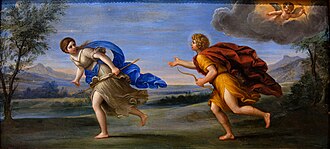
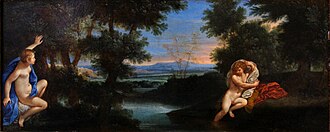
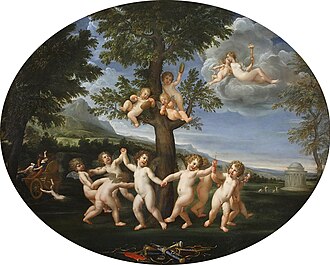
艺廊
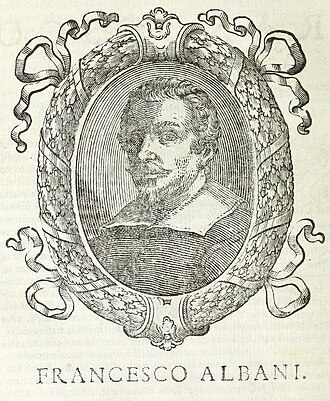
资料卡
资料来自 Wikidata Q358147(CC0)。
生平与创作
弗朗切斯科·阿尔巴尼(意大利语:Francesco Albani或Albano;1578年8月17日—1660年10月4日)是一位意大利巴洛克画家,活跃于家乡博洛尼亚和罗马等地。
生平
他出生于博洛尼亚,其父本来想教他经商,但12岁时在画家丹尼斯·卡尔法特手下当学徒遇到了圭多·雷尼,随后从圭多·雷尼学画。
1600年移居罗马,1602年至07年间为圣母圣心堂绘制壁画,1606至07年间为马太府绘制壁画,1609年为巴萨诺罗马诺的一座府邸(Palazzo Giustiniani,今Palazzo Odescalchi)绘制天顶画,1612年为和平圣母教堂绘制壁画,1616年在科尔索大道为“Palazzo Verospi”绘制壁画。后来他开始与原来的师傅圭多·雷尼竞争,但实际仍十分尊重他的老师,并且受其指导在奎里纳尔宫的一个小圣堂里工作。
他的妻子死后,阿尔巴尼回到家乡博洛尼亚并再度结婚,他一直居住在这里直到逝世。
摘自维基百科「弗朗切斯科·阿尔巴尼」,按 CC BY-SA 4.0 使用,繁体已转简体,去掉了参考文献、外部链接等尾部小节和表格,其余文字未作改动。
中文条目比较短,展开看英文维基百科的条目(英文原文)
Francesco Albani or Albano (17 March or 17 August 1578 – 4 October 1660) was an Italian Baroque painter of Albanian descent who was active in Bologna (1591–1600; 1609; 1610; 1618–1622), Rome (1600–1609; 1610–1617; 1623–1625), Viterbo (1609–1610), Mantua (1621–1622) and Florence (1633). He was a distinguished artist of the Bolognese school, deeply influenced by Annibale Carracci’s classicism. His fame rests on his idyllic landscapes and small mythological pictures, the lyrical qualities of which earned him the soubriquet ‘the Anacreon of painters’.
Early years in Bologna
Albani was born in Bologna, Papal States, in 1578, the second surviving son of Elisabetta Torri and Agostino Albani. His father was a silk merchant who intended his son to go into his own trade. By the age of twelve, however, he had become an apprentice to the competent mannerist painter Denis Calvaert, in whose studio he met Guido Reni. He soon followed Reni to the so-called "Academy" run by Annibale, Agostino, and Ludovico Carracci. This studio fostered the careers of many painters of the Bolognese school, including Domenichino, Massari, Viola, Lanfranco, Giovanni Francesco Grimaldi, Pietro Faccini, Remigio Cantagallina, and Guido Reni.
Albani studied for four years under Ludovico Carracci. Through his master, he secured his initial public commissions, which closely followed Ludovico's style. These were for Bolognese palazzi and churches, such as the Oratory of San Colombano, where his fresco of the Repentance of St. Peter (c. 1597–8) closely imitates the dramatic and emotional qualities of Ludovico’s manner, particularly in the expressive figure of the apostle and in the nocturnal lighting. The oratory’s altarpiece, painted in the same period, showing the Risen Christ Appearing to the Virgin, is, however, more indebted to Annibale Carracci for its general composition and individual motifs.
This change of mentor signalled a decisive shift in Albani’s approach, which increasingly inclined towards Annibale’s idealizing and classicizing style. According to Carlo Cesare Malvasia, Albani’s work in San Colombano stood out from that of the other Carracci pupils for its invention and expression. An altarpiece painted in 1599, the Virgin and Child Enthroned with St. Catherine of Alexandria and St. Mary Magdalene in Santi Fabiano e Sebastiano, Bologna, marks the start of Albani’s career as an independent master. This, his first dated work, exemplifies the elements of his initial style. Its composition is indebted to Annibale’s altarpiece of the Virgin and Child Enthroned (1593; Pinacoteca Nazionale di Bologna), while the intimate mood, slight figural proportions, graceful attitudes, sfumato and sweet facial expressions reflect Albani’s study of Antonio da Correggio.
Mature work in Rome
In 1600, Albani moved to Rome to work on the fresco decoration of the gallery of the Palazzo Farnese, which was being completed by the studio of Annibale Carracci. At this time, Rome, under Clement VIII Aldobrandini (1592–1605), was exhibiting some degree of administrative stability and renewed artistic patronage. While Pope Clement had been born into a Florentine family resident in Urbino, his family was allied by marriage to the Emilia-Romagna and the Farnese, since Ranuccio I Farnese, Duke of Parma had married Margherita Aldobrandini. Parma, like Bologna, being part of the Region of Emilia-Romagna, it was not surprising that Cardinal Odoardo Farnese, Ranuccio's brother, chose to patronise the Carraccis from Bologna, thereby establishing Bolognese dominance of Roman fresco painting for nearly two decades.
Albani became one of Annibale's most prominent apprentices. Using Annibale's designs and assisted by Lanfranco and Sisto Badalocchio, Albani completed frescoes for the San Diego Chapel in San Giacomo degli Spagnoli between 1602 and 1607. Elaborating on Annibale’s sketches, Albani learnt to design classicizing compositions in which monumental figures enact the narrative through expressive gesture. He also supervised the completion of the Aldobrandini lunettes (c. 1604–5 / 1610–13; Rome, Galleria Doria Pamphilj), left unfinished on Annibale’s death in 1609. The lunette of the Landscape with the Assumption shows Albani’s assimilation of his mentor’s landscape style: small figures move against a grand landscape, the idealized forms of which complement the sacred narrative.
节选,摘自英文维基百科「Francesco Albani」,按 CC BY-SA 4.0 使用。
师承与影响
同时代的教皇国画家
流派与收藏
作品(14)