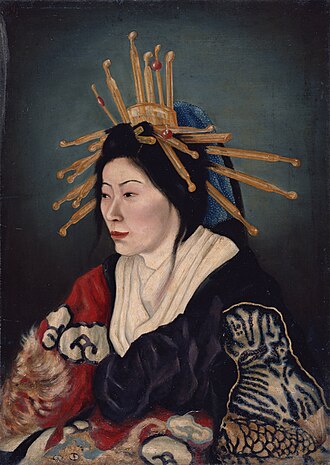
艺廊
资料卡
- 出生
- 1828 年
- 出生地
- 大手町
- 去世
- 1894 年
- 逝世地
- 根岸
- 安葬地
- Shōun-ji Temple
- 国籍
- 大日本帝国、江户幕府
- 职业
- 画家
- 领域
- 绘画
- 流派
- 洋画家
- 老师
- 查尔斯・威格曼、安东尼欧·冯塔聂西、Kawakami Tōgai
- 学生
- 原田直次郎、Harusada II Yasukawa、川端玉章、Awashima Chingaku、Araki Kanpo、Takahashi Genkichi
- 就读
- 洋书调所
资料来自 Wikidata Q3514137(CC0)。
生平与创作
高桥由一(日语:高桥 由一/たかはし ゆいち,罗马化:Takehashi Yuichi,1828年3月20日—1894年7月6日)出生于江户,是日本西洋画画家。他最初学习狩野派绘画,之后转向西洋画领域,师从川上冬崖、查尔斯·瓦格曼、安东尼奥·丰塔内西等人。1873年,他创办了画塾天绘社,培养了淡岛椿岳和川端玉章等西洋画家。他被视为近代日本西洋画的开拓者,作品包括《岩仓具视像》《花魁》《鲑》《豆腐及油扬図》《酢川にかかる常盘桥》等。
摘自维基百科「高桥由一」,按 CC BY-SA 4.0 使用,繁体已转简体,去掉了参考文献、外部链接等尾部小节和表格,其余文字未作改动。
中文条目比较短,展开看英文维基百科的条目(英文原文)
Takahashi Yuichi (高橋 由一; The childhood name is Inosuke, and later Yunosuke. (March 20, 1828 – July 6, 1894) was a Japanese painter, noted for his pioneering work in developing the yōga (Western-style) art movement in late 19th-century Japanese painting.There were many Japanese painters who tried Western painting and Western style painting in the modern age, but Yuichi is said to be the first "Western painter" in Japan who learned full-scale oil painting techniques and was active from the late Edo period to the middle of the Meiji era.
Biography
Takahashi was born to a samurai-class household at the Edo residence of Sano Domain, a subsidiary han of Sakura Domain, where his father was a retainer of the Hotta clan. Interested in art from childhood, he apprenticed to the Kanō school, but later became fascinated with western-style art through lithographs which were being available in Japan during the Bakumatsu period. In 1862, he obtained a place in the arts department of the Bansho Shirabesho, the Tokugawa shogunate's research institute in western learning, where he studied under Kawakami Togai, and where he began experimentation with oil painting. In 1866, he went to Yokohama to study under the English artist and cartoonist Charles Wirgman, who was so impressed with his talent that he sponsored his participation in the Paris World Exhibition of 1867.
After the Meiji Restoration, despite his largely self-taught credentials, he was appointed a professor of art at the Kobubijutsu Gakkō (the Technical Fine Arts School) by the new Meiji government, and was a student and an assistant for the Italian foreign advisor Antonio Fontanesi, who had been hired by the Meiji government in the late 1870s to introduce western oil painting to Japan.
In 1879, he entered a contest sponsored by the Kotohira-gū shrine in Shikoku for ceiling panel paintings, donating all of the paintings to the shrine after the contest. The shrine still displays a collection of 27 of his paintings. Also in 1879, Takahashi was recommended by the Genrōin to become a court painter, and was commissioned to paint a portrait of the emperor.
In 1881, he received a large commission from Viscount Mishima Michitsune to paint scenes of public works projects in Yamagata prefecture.
Takahashi produced mostly portraiture and landscape paintings, but also still life works. His best-known painting is a salmon hung up to dry, which has been recognized by the Agency for Cultural Affairs of the Japanese government as an Important Cultural Property of Japan.
He died at home in 1897.
摘自英文维基百科「Takahashi Yuichi」,按 CC BY-SA 4.0 使用。