艺廊
资料卡
- 本名
- 中村鈼太郎
- 出生
- 1866 年
- 出生地
- 八丁堀、凑
- 去世
- 1943 年
- 逝世地
- 根岸
- 安葬地
- 多磨灵园
- 国籍
- 日本
- 职业
- 艺术家、画家、书法家
- 老师
- 拉斐尔·科兰、让-保罗·洛朗斯、小山正太郎
- 学生
- 菱田春草、樋口秀雄、杨造化
- 就读
- 朱利安艺术学校
- 所属团体
- 日本艺术院、Taiheiyo Art Association
资料来自 Wikidata Q3335331(CC0)。
生平与创作
中村不折(1866年8月19日—1943年6月6日)是一位日本画家。
生平
1866年出生于日本东京都中央区凑,幼年因明治维新动乱随父母逃避至长野县伊那市,学习中文古典典籍和南画,1887年返回东京都学习绘画,师从小山正太郎。1894年遇见正冈子规进入新闻社“日本”担任记者,1896年和正冈子规从军参加甲午战争,并对中国的书籍感兴趣。1897年结婚继续为新闻社供画稿。凭借《红叶村》在1900年世界博览会上获奖。之后赴法学习,1905年返回日本创立太平洋美术会。曾经为岛崎藤村、森鸥外、夏目漱石、伊藤左千夫的著作供插图。
1943年6月6日因脑溢血在东京都台东区下谷的家中逝世,享年77岁。
纪念
2000年在其旧居处设立台东区立书道博物馆。
资源
Suzuki, Toshihiko (Ed.): "Nakamura Fusetsu". In: 日本大百科全书, Shogakukan, 2001.
Laurance P. Roberts: "Nakamura Fusetsu". In: A Dictionary of Japanese Artists. Weatherhill, 1976. ISBN 0-8348-0113-2
摘自维基百科「中村不折」,按 CC BY-SA 4.0 使用,繁体已转简体,去掉了参考文献、外部链接等尾部小节和表格,其余文字未作改动。
中文条目比较短,展开看英文维基百科的条目(英文原文)
Nakamura Fusetsu (中村 不折; originally Sakutarō, 19 August 1866, Tokyo – 6 June 1943, Tokyo) was a Japanese painter in the yōga style. He was also known as a calligrapher.
Life and work
When he was still a child, his family moved to Nagano Prefecture to escape the difficulties created by the Meiji Restoration. After showing an aptitude for art, he received lessons in nanga and European-style painting. He returned to Tokyo in 1887 to take lessons from Koyama Shōtarō at a school operated by the "Association of the Eleventh" (十一次会) then, later, at Koyama's own school; "Fudō-sha" (不同社; roughly, Diversity).
In 1894, he met the poet, Masaoka Shiki, who also worked as a journalist, and obtained a position doing illustrations for Small Japanism, an Anti-colonialist newspaper. It was at this time that he began using the name "Fusetsu" (infallible). In 1895, he went to China in the company of Masaoka, who was then working as a war correspondent. There, he painted scenes from the First Sino-Japanese War and developed an interest in calligraphy. Later, he worked for both the Nippon Shimbun and the Asahi Shimbun.
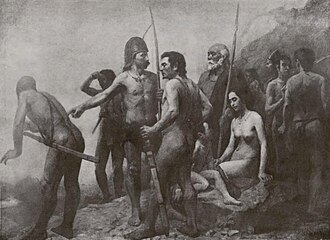
In 1900, he submitted paintings to the Exposition Universelle in Paris and received a small prize. Shortly after, he went to France to study with Raphaël Collin; then with Jean-Paul Laurens, who had been one of Koyama's instructors when he was there. Upon returning to Japan in 1905, he became a member of "Pacific Art, a group devoted to the promotion of Western-style painting. His first showing included a portrayal of the Imperial Family's ancestor goddess, Amaterasu, and her seven protectors, which drew the ire of Kuki Ryūichi, the Minister of Education, because they were portrayed in the nude. The painting was later destroyed in the Great Kantō Earthquake.
He sat on the jury for several showings, including the first Tokyo Industrial Exhibition and the first Ministry of Culture Art Exhibition. In 1919, he was elected a member of the Japan Art Academy. He also did book illustrations; notably for I am a Cat by Natsume Sōseki (1906), and the Blue Cliff Record.
He was not only a calligrapher himself, but spent his life collecting examples of Classical calligraphy; both Japanese and Chinese. In 1936, he used his collection to establish a calligraphy museum in Tokyo. It was maintained by the Nakamura family until 1995, when it was donated to Taitō, a Special Ward of Tokyo.
摘自英文维基百科「Nakamura Fusetsu」,按 CC BY-SA 4.0 使用。