艺廊
资料卡
- 出生
- 1802 年
- 出生地
- 伦敦
- 去世
- 1873 年
- 逝世地
- 伦敦
- 安葬地
- 圣保罗座堂
- 国籍
- 大不列颠及爱尔兰联合王国
- 职业
- 艺术家、画家、雕塑家、建筑绘图员、蚀刻家
- 领域
- 年轻成人小说
- 流派
- 浪漫主义
- 就读
- 皇家艺术学院
- 所属团体
- 皇家艺术学院
- 获奖
- Pour le Mérite for Sciences and Arts order
- 父亲
- John Landseer
- 母亲
- Jane Potts
资料来自 Wikidata Q328369(CC0)。
生平与创作
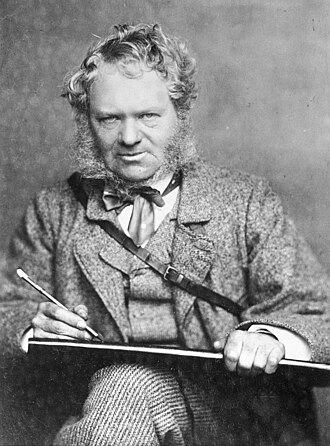
埃德温·亨利·兰德希尔爵士 RA(1802年3月7日-1873年10月1日)是英国画家与雕塑家,以描绘动物的作品闻名,尤以马、犬与雄鹿为主。他最著名的作品为位于特拉法加广场纳尔逊纪念柱基座上的狮子雕塑。
摘自维基百科「埃德温·兰西尔」,按 CC BY-SA 4.0 使用,繁体已转简体,去掉了参考文献、外部链接等尾部小节和表格,其余文字未作改动。
中文条目比较短,展开看英文维基百科的条目(英文原文)
Sir Edwin Henry Landseer (7 March 1802 – 1 October 1873) was an English painter and sculptor, well known for his paintings of animals – particularly horses, dogs, and stags. His best-known work is the lion sculptures at the base of Nelson's Column in Trafalgar Square.
Life
Landseer was born in London, the son of the engraver John Landseer A.R.A. and Jane Potts. He was something of a prodigy whose artistic talents were recognised early on. He studied under several artists, including his father, and the history painter Benjamin Robert Haydon, who encouraged the young Landseer to perform dissections in order to fully understand animal musculature and skeletal structure. Landseer's life was entwined with the Royal Academy. At the age of just 13, in 1815, he exhibited works there as an “Honorary Exhibitor”. He was elected an Associate at the minimum age of 24, and an Academician five years later in 1831.
He was an acquaintance of Charles Robert Leslie, who described him as "a curly-headed youngster, dividing his time between Polito's wild beasts at Exeter Change and the Royal Academy Schools." They also visited Scotland together in 1824, which had a great effect upon Landseer.
In 1823 Landseer was commissioned to paint a portrait of Georgiana Russell, Duchess of Bedford. Despite her being twenty years older than he was, they began an affair. Contemporary gossip had it that Landseer was the father of at least one of her children, Lady Rachel Russell.
He was knighted in 1850, and although elected to be President of the Royal Academy in 1866 he declined the invitation and the position went to Francis Grant. In his late thirties Landseer suffered what is now believed to be a substantial nervous breakdown, and for the rest of his life was troubled by recurring bouts of melancholy, hypochondria, and depression, often aggravated by alcohol and drug use. In the last few years of his life Landseer's mental stability was problematic, and at the request of his family he was declared insane in July 1872.
Painting
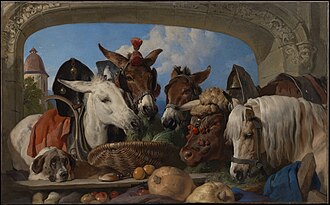
Landseer was a notable figure in 19th-century British art, and his works can be found in Tate Britain, the Victoria and Albert Museum, Kenwood House and the Wallace Collection in London. He also collaborated with fellow painter Frederick Richard Lee.
Landseer's popularity in Victorian Britain was considerable, and his reputation as an animal painter was unrivalled. Much of his fame – and his income – was generated by the publication of engravings of his work, many of them by his brother Thomas.
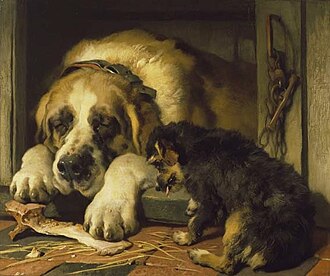
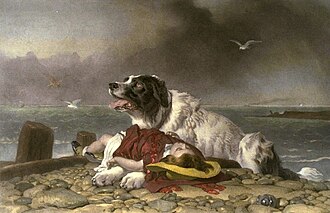
One of his earliest paintings is credited as the origin of the myth that St. Bernard rescue dogs in the Alps carry a small casket of brandy on their collars. Alpine Mastiffs Reanimating a Distressed Traveller (1820) shows two of the dogs standing over a man who is partially buried in snow. One is barking to attract attention while the other, who is depicted with the miniature barrel, attempts to revive the man by licking his hand.
His appeal crossed class boundaries: reproductions of his works were common in middle-class homes, while he was also popular with the aristocracy. Queen Victoria commissioned numerous pictures from the artist. Initially asked to paint various royal pets, he then moved on to portraits of ghillies and gamekeepers. Then, in the year before her marriage, the queen commissioned a portrait of herself. He taught both Victoria and Albert to etch, and made portraits of Victoria's children as babies, usually in the company of a dog. He also made two portraits of Victoria and Albert dressed for costume balls, at which he was a guest himself. One of his last paintings was a life-size equestrian portrait of the Queen, shown at the Royal Academy in 1873, made from earlier sketches.
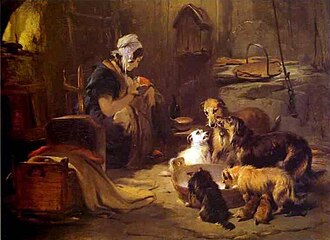
Landseer was particularly associated with Scotland, which he had first visited in 1824 and the Highlands in particular, which provided the subjects (both human and animal) for many of his important paintings. The paintings included his early successes The Hunting of Chevy Chase(1825–26), The Illicit Highland Whisky Still (1826–1829) and his more mature achievements, such as the majestic stag study The Monarch of the Glen (1851) and Rent Day in the Wilderness (1855–1868). In 1828, he was commissioned to produce illustrations for the Waverley Edition of Sir Walter Scott's novels.
节选,摘自英文维基百科「Edwin Landseer」,按 CC BY-SA 4.0 使用。
同时代的大不列颠及爱尔兰联合王国画家
流派与收藏
作品(44)