艺廊
资料卡
- 出生
- 1838 年
- 出生地
- 皮埃尔莱
- 去世
- 1891 年
- 逝世地
- 巴黎十七区
- 国籍
- 法国
- 职业
- 画家
- 流派
- 巴比松画派
- 学生
- Eugène Galien-Laloue、Ernest Victor Hareux、Ernest Baillet
- 获奖
- 法国荣誉军团骑士勋章
资料来自 Wikidata Q3270988(CC0)。
生平与创作
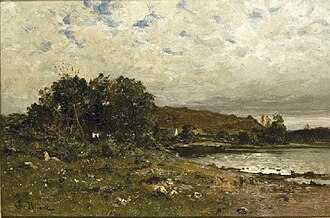
Léon Germain Pelouse (1 October 1838 – 31 July 1891) was a largely self-taught painter born in Pierrelaye, France. His work was most often said to descend from that of Corot and Daubigny, but was from the beginning unique in its depiction of an often stark, obsessively detailed nature largely devoid of human figures. At the time of his death at age 52 in Paris, Pelouse was "considered one of the great landscape painters of his time."
Life and career
Pelouse was born and spent his first eleven years in the small village of Pierrelaye, into a family of little means. In 1849 his family moved to Paris and, five years later, on the death of his father, Léon-Germain, having to earn a living, at sixteen began working as a traveling salesman for his uncle, a draper.
He began painting as an amateur and took some evening classes. His professional painting career began at age twenty-seven, with the acceptance and exhibition of his Les Environs de Précy at the Paris Salon of 1865. The work made a strong impression, especially coming from a painter without the usual Academic education. "From the beginning," wrote Albert Patin de La Fizelière, Pelouse displayed "the easy grace, brilliance, and suppleness of execution that have since been admired in his canvases."
Inspired by this success, despite the offer of a partnership with his uncle and against the opposition of his mother, with whom he quarreled, Pelouse left his sales job to become a painter full-time. He traveled to Brittany, and there, inspired by nature around Pont-Aven, Concarneau, and Rochefort-en-Terre, painted landscapes that were exhibited at the Paris Salon in following years. From 1873, when he received a second-class medal at the Salon, for Vallée de Cernay, he gained mounting success and critical acclaim. In 1876, his Une Coupe de bois à Senlisse received a first-class medal, "a reward which for thirty years had not been given to a landscape painter."
Pelouse became a prolific and sought-after artist. In 1884, Eugène Montrosier wrote, "Díaz de la Peña produces paintings like apple trees give apples, it has been said. One could write as much of M. Pelouse who, without a master, by the sole force of his will, has succeeded in a few years to take one of the first places among modern landscape painters" and to become "one of the most distinguished painters of the young school."
Pelouse's fame spread to North America. Scribner's Monthly, reviewing the Paris Salon of 1878, wrote that Pelouse's "style is impressive, his pictures rich and daring in color, the execution marked by the greatest breadth and freedom of handling....he shows an imagination equal to that of Daubigny." In the 1880s, Pelouse was "the most prestigious" of the French artists whose work was imported to Canada by W. Scott & Sons of Montreal.
In 1878 Pelouse was made a Chevalier of the Legion of Honor. In 1889 he was awarded a gold medal at the Universal Exhibition in Paris. From 1884 to 1890 he served on the jury of the Paris Salon. Georges Lanoë-Villène says that Pelouse "was all-powerful on the jury."
Pelouse died in 1891, at age 52, of complications from diabetes. He was interred in a vault in the cemetery of Le Pré-Saint-Gervais in Paris. At his funeral, William-Adolphe Bouguereau spoke of Pelouse's character:"What a frank, loyal, and cheerful nature! How happy we felt to be with him. What inexhaustible verve, what fine wit, what benevolence and kindness! His pupils, who lived next door to him in the country, can tell what treasures this heart contained. And in difficult times, how good and consoling was his faithful friendship! His sensitive soul was indignant at injustices. With what gratitude he cherished the memory of the slightest services that others had been able to render him!"
A posthumous retrospective of more than 250 of his works, inaugurated by the President of the Republic, Sadi Carnot, was exhibited in 1892 at the École des Beaux-Arts in Paris. In 1897, a monument to his memory, surmounted by a bronze bust by Alexandre Falguière, was erected and dedicated in Cernay.
The French government bought many of his works, now in the collections of numerous museums, including the Musée d'Orsay, the Musée Malraux, and the Musée des Beaux-Arts de Nantes. His works are also held in the Metropolitan Museum in New York, and in museums in San Francisco, Ghent, Oslo, Munich, and Sydney.
École de Cernay; students
During the Franco-Prussian War of 1870, Pelouse enlisted in the national guard. During his service, he spent time in the town of Cernay-la-Ville, near Paris, and experienced a powerful attraction to the surrounding scenery. After the war, in 1871, Pelouse walked on foot from Paris to Cernay, which had been ransacked by the Prussians, and took lodgings at the inn of Léopold Lequesne. In 1876, with his wife and stepson, he rented a small house on the village square. He would eventually have numerous ateliers in the area, including "a barn next to the tiny church that the Rothschilds, those gold powerhouses, had restored."
"Poverty made him frugal, handy, and ingenious...he made his own clothes and even his hats and shoes; he wanted to save his money for brushes and paints." It was Pelouse's habit to wear a peasant blouse and sabots, setting out with his easel and paints at daybreak, "often forgetting meals and only returning a long time after sunset." "As Claude Monet did in 1867 with Women in the Garden, Pelouse did not hesitate to set up large-format canvases in the countryside in order to be able to paint them entirely en plein air." He wouldset up, like a theater set, a whole installation: tent, boards, parasols, easels, in woods, or plains, or along the course of a stream, carrying everywhere with him and without help a genuinely mobile atelier. Once camped like this, the work began, and nothing and no one could tear him away from the study undertaken before he had delivered the final brushstroke. His determination was such that, wishing to complete a study of snow at Cernay in 1872, he spent part of the day without thinking for a moment of the horrible cold that enveloped him; the next day, he learned from the newspapers that the thermometer had dropped to 24 degrees below zero!
原文较长,这里只摘了前面一部分,摘自英文维基百科「Léon Germain Pelouse」(暂时没有中文条目,下面是英文原文),按 CC BY-SA 4.0 使用,去掉了参考文献、外部链接等尾部小节和表格,其余文字未作改动。