艺廊

资料卡
- 出生
- 1857 年
- 出生地
- 鹿特丹
- 去世
- 1923 年
- 逝世地
- 阿姆斯特丹
- 安葬地
- Amsterdam New Eastern Cemetery
- 国籍
- 荷兰王国
- 职业
- 摄影师、画家、建筑绘图员、水彩画家、蚀刻家、版画家 等 9 项
- 流派
- 海牙画派
- 学生
- Coba Ritsema
- 就读
- 海牙皇家艺术学院、威廉·埃德·库宁学院、Rijksakademie van beeldende kunsten、Polytechnical School in Delft、海牙绘画学院
- 所属团体
- Arti et Amicitiae
- 获奖
- Royal Prize for Painting
- 配偶
- Marie Jordan
资料来自 Wikidata Q289441(CC0)。
生平与创作
乔治·亨德里克·布莱特纳(荷兰语:George Hendrik Breitner;1857年9月12日—1923年6月5日),是荷兰知名的画家和摄影师,也是阿姆斯特丹印象派的著名代表人物。
生平
他1857年出生在鹿特丹,曾经在海牙的皇家艺术学院学习,又去巴黎学习印象派画作,1886年搬到荷兰首都阿姆斯特丹。因为写实风格的街道和港口而名噪一时,时常记录着街头生活和天气变化,特别是雨天作为自己绘画的原料灵感。1892年被授予皇家绘画奖。
摘自维基百科「乔治·亨德里克·布莱特纳」,按 CC BY-SA 4.0 使用,繁体已转简体,去掉了参考文献、外部链接等尾部小节和表格,其余文字未作改动。
中文条目比较短,展开看英文维基百科的条目(英文原文)
George Hendrik Breitner (12 September 1857 – 5 June 1923) was a Dutch painter and photographer. An important figure in Amsterdam Impressionism, he is noted especially for his paintings of street scenes and harbours in a realistic style. He painted en plein air, and became interested in photography as a means of documenting street life and atmospheric effects – rainy weather in particular – as reference materials for his paintings.
Biography
George Hendrik Breitner was born in Rotterdam, Netherlands.
From 1876 to 1880 he attended the Art Academy in The Hague where his extraordinary talent was rewarded on various occasions. From October 1878 till April 1879 he worked as an art teacher at the Leiden academy Ars Aemula Naturae. In 1880 he was expelled from the Art Academy of The Hague for misconduct, because he had destroyed the regulations-board. In the same year he lived at landscapist Willem Maris's place at Loosduinen and was accepted as a member of Pulchri Studio, an important artist's society in The Hague. Later, he distanced himself from the Hague School and today he is generally regarded as an Amsterdam Impressionist.
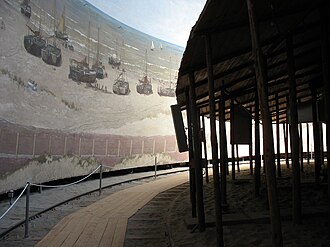
During 1880–1881 he worked at the famous Panorama Mesdag together with Hendrik Mesdag, S. Mesdag-van Houten, Theophile de Bock and Barend Blommers. In 1882 he met and worked together with Vincent van Gogh, with whom he often went sketching in the poorer areas of The Hague. Breitner preferred working-class models: labourers, servant girls and people from the lower class districts. Interest in the lot of the common people, which many artists felt in that period, was nurtured by the social conscience of French writers such as Émile Zola.
He was associated with the Dutch literary group known as the Tachtigers (English translation: "Eighty-ers"). This was a group that championed impressionism and naturalism against romanticism, influencing other painters such as Isaac Israëls, Willem Witsen, and poets like Willem Kloos.
In 1886, he entered the Rijksakademie of Amsterdam, but soon it became clear that Breitner was far beyond the level of education offered there.
Breitner saw himself as "le peintre du peuple", the people's painter. He was the painter of city views par excellence: wooden foundation piles by the harbour, demolition work and construction sites in the old centre, horse trams on the Dam, or canals in the rain. With his nervous brush strokes, he captured the dynamic street life. By 1890, cameras were affordable, and Breitner had a much better instrument to satisfy his ambitions. He became very interested in capturing movement and illumination in the city, and became a master in doing this. It is not impossible that Breitner's preference for cloudy weather conditions and a greyish and brownish palette resulted from certain limitations of the photographic material.
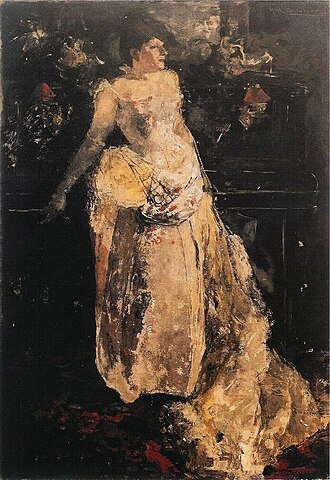
Breitner also painted female nudes, but just like Rembrandt he was criticized because his nudes were painted too realistically and did not resemble the common ideal of beauty. In his own time Breitner's paintings were admired by artists and art lovers, but often despised by the Dutch art critics for their raw and realistic nature.
By the turn of the century Breitner was a famous painter in the Netherlands, as demonstrated by a highly successful retrospective exhibition at Arti et Amicitiae in Amsterdam (1901). Breitner travelled frequently in the last decades of his life, visiting Paris, London, and Berlin, among other cities, and continued to take photographs. In 1909 he went to the United States as a member of the jury for the Carnegie International Exhibition in Pittsburgh.
Although Breitner exhibited abroad early on, his fame never crossed the borders of the Netherlands. At the time foreign interest was more for anecdotal and picturesque works; the typical "Dutchness" of the Hague School. As time went by critics lost interest in Breitner. The younger generation regarded impressionism as too superficial. They aspired to a more elevated and spiritual form of art, but Breitner did not allow himself to be influenced by these new artistic trends. Around 1905–1910 pointillism as practised by Jan Sluyters, Piet Mondrian and Leo Gestel was flourishing. Between 1911 and 1914 all the latest art movements arrived in the Netherlands one after another including cubism, futurism and expressionism. Breitner's role as contemporary historical painter was finished.
节选,摘自英文维基百科「George Hendrik Breitner」,按 CC BY-SA 4.0 使用。
师承与影响
同属「日本主义」的画家
流派页 ›同时代的荷兰王国画家
流派与收藏
作品(13)