艺廊
资料卡
- 出生
- 9 世纪
- 出生地
- 长安
- 去世
- 960 年
- 逝世地
- 长安
- 国籍
- 中国
- 职业
- 画家
- 领域
- 绘画
- 流派
- Northern Landscape style
- 受谁影响
- 荆浩
资料来自 Wikidata Q2559287(CC0)。
生平与创作
关仝(?—?),陕西长安人,中国五代后梁时期的山水画画家。与他的师父荆浩在画史上合称“荆关山水”,自创有“关家山水”,在秦岭、华山一代活动。现存作品有《秋山晚翠图》、《关山行旅图》。
关仝与李成、范宽在北宋并称为“三家山水”。其门生包括郭忠恕、王士元、刘永、王端等。
作品
《关山行旅图》,藏于台湾台北国立故宫博物院
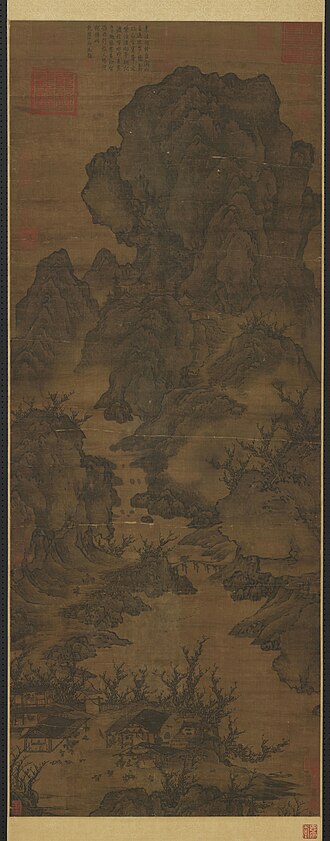
《山谿待渡图》,藏于台湾台北国立故宫博物院
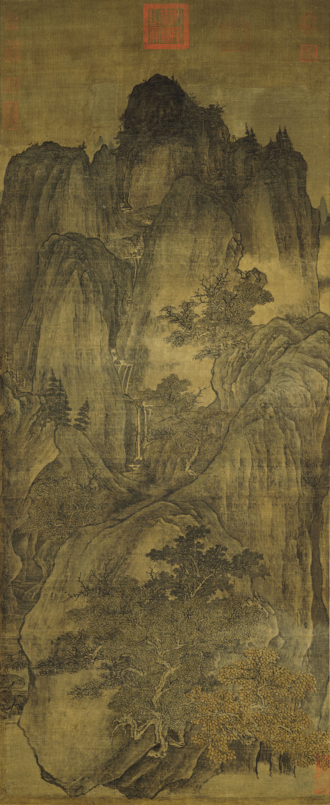
《秋山晚翠图》,藏于台湾台北国立故宫博物院
《蜀山栈道图》,藏于台湾台北国立故宫博物院
摘自维基百科「关仝」,按 CC BY-SA 4.0 使用,繁体已转简体,去掉了参考文献、外部链接等尾部小节和表格,其余文字未作改动。
中文条目比较短,展开看英文维基百科的条目(英文原文)
Guan Tong (simplified Chinese: 关仝; traditional Chinese: 關仝; pinyin: Guān Tóng; Wade–Giles: Kuan T'ung) (c. 906-960) was a Chinese painter of the Northern Landscape style during the Five Dynasties and Ten Kingdoms period and early Song dynasty from the city of Chang'an. He was a pupil of Jing Hao, and known as a critical figure in the development of the era's monumental landscape painting. His landscape paintings achieved a believable and compelling portrayal of the natural world, an achievement typifying the tenth-century artists drive in the portrayal of nature. The great popularity Guan's distinctive style achieved is one measure of the popularity of landscape painting at the time.
Autumn Mountain Shadow is one of the paintings attributed to Guan Tong, and although there are several works attributed to him, there are no extant works bearing his signature. In this picture a barely visible steep path climbs through the rugged mountains. The work appears to be the visual equivalent of the poems describing hard journeys such as Li Bai's The Road to Shu is Hard (Shudao nan). Guan's works focus also on the representation of the cyclical seasons of nature: a concept central to Chinese medicine and many schools of Chinese philosophy.
Guan Tong favored the use of 'axe chopped' brushstrokes, Fu Pi Cun, to depict the angular rocky forms of the northern mountains. His strong peaks and densely compacted composition represents the northern tradition in its most likely form as scholars understand it today. Scholars describe Guan's works, along with certain pieces by his teacher Jing Hao, as advanced and impressive pieces for their era, and not works that should be counted as inferior or preliminary to the mature landscape art of the Song.
"Mid-Spring Goldleaf" in the Temple of Hangzhou is another work thought to have been created by Guan, though some have attributed it to Dai Li instead.
Twentieth-century artist Chang Dai-chien forged a painting which was successfully passed off as an original by Guan Tong; the painting was purchased by the Museum of Fine Arts, Boston in 1957 and was assumed, at the time, to be a work by Guan Tong. The painting is considered one of Chang's most ambitious and audacious forgeries.
摘自英文维基百科「Guan Tong」,按 CC BY-SA 4.0 使用。