艺廊
资料卡
- 出生
- 1810 年
- 出生地
- 塞夫尔
- 去世
- 1865 年
- 逝世地
- 巴黎第九区
- 安葬地
- 蒙马特公墓
- 国籍
- 法国
- 职业
- 画家
- 流派
- 巴比松画派
- 老师
- 卡米耶·罗克普朗、Denis Désiré Riocreux
- 学生
- 欧仁·布丹、Emile van Marcke、Gabriel Gervais Chardin、Léon Belly、Martin Léonce Chabry
- 受谁影响
- 保卢斯·波特
- 代表作
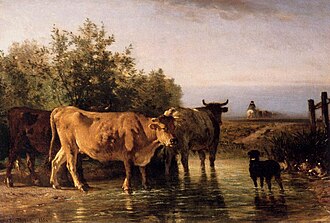
- Sheep in a forest、Oxes watching to tillage, morning sky
- 获奖
- 法国荣誉军团骑士勋章、Knight of the Order of Leopold
资料来自 Wikidata Q219403(CC0)。
生平与创作
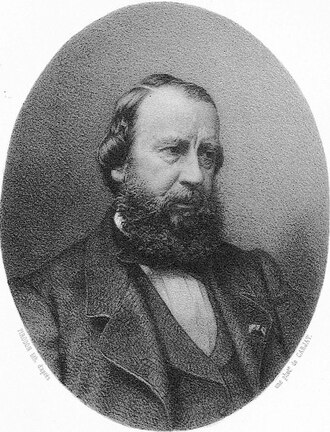
康斯坦·特鲁瓦永(法语:Constant Troyon,法语发音:[kɔ̃stɑ̃ tʁwajɔ̃];1810年8月28日—1865年2月21日)是一位法国画家,也是巴比松画派的主要成员之一。
康斯坦·特鲁瓦永是著名的动物画家,并巴比松画派关系密切。
1846年,康斯坦·特鲁瓦永前往荷兰,在海牙看到保卢斯·波特(Paulus Potter)的著名画作《小公牛》。康斯坦·特鲁瓦永以克伊普的风景和伦勃朗的名作来改变绘画方法。当康斯坦·特鲁瓦永开始以动物为主题作画后,他逐渐获得成功,作品成为英国和美国公认的经典。
摘自维基百科「康斯坦·特鲁瓦永」,按 CC BY-SA 4.0 使用,繁体已转简体,去掉了参考文献、外部链接等尾部小节和表格,其余文字未作改动。
中文条目比较短,展开看英文维基百科的条目(英文原文)
Constant Troyon (French pronunciation: [kɔ̃stɑ̃ tʁwajɔ̃]; August 28, 1810 – February 21, 1865) was a French painter of the Barbizon school. In the early part of his career, he painted mostly landscapes. It was only comparatively late in life that Troyon found his métier as a painter of animals, and achieved international recognition.
Early years
He was born in Sèvres, near Paris, where his father was connected with the famous manufactory of porcelain. Troyon entered the ateliers very young as a decorator, and until he was twenty, he labored assiduously at the minute details of porcelain ornamentation; and this kind of work he mastered so thoroughly that it was many years before he overcame its limitations. By the time he reached twenty-one, he was travelling the country as an artist, and painting landscapes so long as his finances lasted. Then when pressed for money, he made friends with the first china manufacturer he met and worked steadily at his old business of decorator until he had accumulated enough funds to permit him to start again on his wanderings.
Later development
Troyon was a favorite with Camille Roqueplan, an artist of distinction eight years his senior, and he became one of his pupils after receiving certain tuition from a painter, now quite unknown, named Alfred Riocreux. Roqueplan introduced Troyon to Rousseau, Jules Dupré, and the other Barbizon painters, and in his pictures between 1840 and 1847, he seemed to endeavour to follow in their footsteps.
But as a landscapist Troyon would never have been recognized as a thorough master, although his work of the period is marked with much sincerity and met with a certain success. It may be pointed out, however, that in one or two pure landscapes of the end of his life, he achieved qualities of the highest artistic kind; but this was after lengthy experience as a cattle painter, by which his talents had become thoroughly developed.
In 1846, Troyon went to the Netherlands, and at the Hague saw Paulus Potter's famous "Young Bull". From the studies he made of this picture, of Cuyp's sunny landscapes, and Rembrandt's noble masterpieces he soon evolved a new method of painting, and it is only in works produced after this time that Troyon's true individuality is revealed. When he became conscious of his power as an animal painter he developed with rapidity and success, until his works became recognized as masterpieces in Britain and America, as well as in all countries of the European Continent.
The art critic Albert Wolff wrote about this period of Troyon, after the exhibition "Cent Chefs-d'Oeuvres" in Paris, 1886: "It was accident and a journey to Holland which revealed to Troyon his true mission, that of an animal painter of the first rank ... At a distance of two centuries Troyon continued the traditions of the celebrated Dutch animal painters without imitating them. Paul Potter was to find a successor worthy of him ... Fancy the astonishment at the sight of Troyon's animals, with their large life, their broad brush-work in deep, pure colors, studied with a discriminating sympathy for every race and species, and moving through landscapes of a master's creation. These were not the fashionable stuffed beasts, but living, moving herds, stretching themselves luxuriously in the sun, breathing the breezes cool with morning, or huddling close together at the approach of the storm."
Success, however, came too late, for Troyon never quite believed in it himself, and even when he could command the market of several countries he still grumbled loudly at the way the world treated him. Yet he was decorated with the Legion of Honour, and five times received medals at the Paris Salon, while Napoleon III was one of his patrons; and it is certain he was at least as financially successful as his Barbizon colleagues.
Troyon died, unmarried, at Paris on 21 February 1865, after a term of clouded intellect. He was buried in the Cimetière de Montmartre in the Montmartre Quarter of Paris.
Recognition
All his famous pictures are of date between 1850 and 1864, his earlier work being of comparatively little value. His mother, who survived him, instituted the Troyon prize for animal pictures at the École des Beaux Arts.……
节选,摘自英文维基百科「Constant Troyon」,按 CC BY-SA 4.0 使用。