艺廊
资料卡
- 本名
- Adolf Gustav Thorsen
- 出生
- 1869 年
- 出生地
- Halse
- 去世
- 1943 年
- 逝世地
- 奥斯陆
- 国籍
- 挪威
- 职业
- 雕塑家、木雕家、版画家
- 领域
- 雕塑艺术、情色艺术
- 学生
- Felix Ezzi
- 获奖
- Knight Grand Cross of the Order of St. Olav、Knight First Class of the Order of St. Olav
资料来自 Wikidata Q213956(CC0)。
生平与创作
古斯塔夫·维格兰(Gustav Vigeland,1869年4月11日—1943年3月12日),挪威雕塑家。他曾去过奥古斯特·罗丹的工作室。而古斯塔夫·维格兰的工作室位于弗鲁格纳公园附近。他也是诺贝尔和平奖奖章的设计者。
摘自维基百科「古斯塔夫·维格兰」,按 CC BY-SA 4.0 使用,繁体已转简体,去掉了参考文献、外部链接等尾部小节和表格,其余文字未作改动。
中文条目比较短,展开看英文维基百科的条目(英文原文)
Gustav Vigeland (11 April 1869 – 12 March 1943), born as Adolf Gustav Thorsen, was a Norwegian sculptor. Gustav Vigeland occupies a special position among Norwegian sculptors, both in the power of his creative imagination and in his productivity. He is most associated with the Vigeland installation (Vigelandsanlegget) in Frogner Park, Oslo. The Vigeland installation made Frogner Park into Norway's most popular tourist attraction, and the park also contains Frogner Manor with the Oslo Museum and the Henriette Wegner Pavilion. Vigeland was also the designer of the Nobel Peace Prize medal.
Early life
Adolf Gustav Thorsen was born to a family of craftsmen in Halsaa og Hartmark Municipality, near the town of Mandal in southern Norway. His parents were Elisæus Thorsen (1835–1886), a cabinetmaker and Anne Aanensdatter (1835–1907). He had three brothers, of whom Emanuel Vigeland (originally Thorsen) became a noted artist. As a youth, he was sent to Oslo where he learned wood carving at a local school. However, the sudden death of his father compelled him to move to Mandal to help his family. Gustav lived for a time with his grandparents on a farm called Mjunebrokka near the village of Vigeland in Søndre Undal Municipality (now part of Lindesnes Municipality).
He returned to Oslo in 1888, this time determined to become a professional sculptor. He came to the attention of sculptor Brynjulf Bergslien, who supported him and gave him practical training. The following year he exhibited his first work, Hagar and Ishmael. In his 20s, he adopted the new family name Vigeland, from the area where he had briefly lived.
Vigeland spent the years 1891 to 1896 in several voyages abroad, including Copenhagen, Paris, Berlin and Florence. In the French capital he frequented Auguste Rodin's workshop, while in Italy he experimented with ancient and Renaissance artworks. In these years the themes that would later dominate his inspiration - death and the relationship between man and woman - first appeared. He held his first personal exhibitions in Norway in 1894 and 1896, which received notable critical praise.
Early public works
Until 1902 Vigeland was engaged in the restoration of the Nidaros Cathedral in Trondheim. The contact with Mediaeval art contributed to another frequent theme in Vigeland's art, the dragon as symbol of sin but also as a nature force, fighting against man.
Back in Oslo, he obtained from the town an abandoned studio in which to work. In 1905 Norway became independent from Sweden. Vigeland, considered the most talented Norwegian sculptor, received numerous commissions for statues and busts celebrating renowned compatriots like Henrik Ibsen and Niels Henrik Abel.
In 1906 Vigeland proposed a chalk model for a monumental fountain. Initially, the idea of the Oslo municipality was to put the fountain in Eidsvolls plass, the square in front of the Parliament of Norway. His work was generally welcomed, but the location created a dispute: completion of the work was postponed by the dispute. In the meantime Vigeland enlarged the original project, adding several sculpture groups. The high granite column was added to the design in 1919.
Vigeland installation
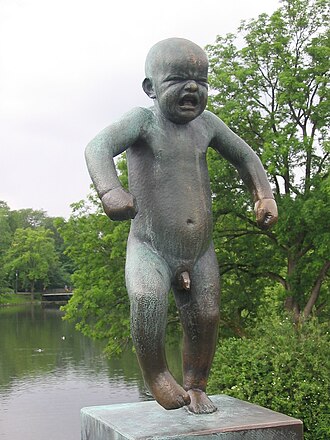
Gustav Vigeland is most widely known for the Vigeland installation, a permanent sculpture installation in Frogner Park in Oslo.
In 1921 the City of Oslo decided to demolish the house where Vigeland lived and build a library. After a long dispute, Vigeland was granted a new building from the city where he could work and live; in exchange, he promised to donate to the city all his subsequent works, including sculptures, drawings, engravings and models.
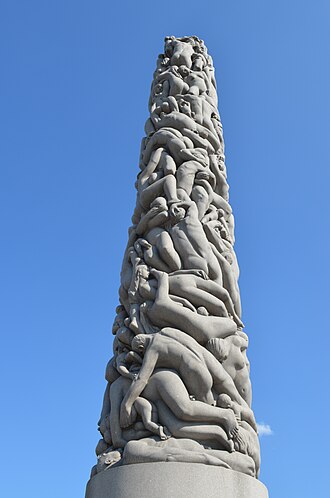
Vigeland moved to his new studio on Nobels gate in the borough of Frogner during 1924. His studio was located in the vicinity of Frogner Park, which he had chosen as the definitive location for his fountain. Over the following twenty years, Vigeland was devoted to the project of an open exhibition of his works, which later turned into what is known as Vigeland Sculpture Arrangement (Vigelandsanlegget) in Frogner Park. The Vigeland installation features 212 bronze and granite sculptures all designed by Gustav Vigeland. The sculptures culminate in the famous Monolith (Monolitten), with its 121 figures struggling to reach the top of the sculpture.
节选,摘自英文维基百科「Gustav Vigeland」,按 CC BY-SA 4.0 使用。