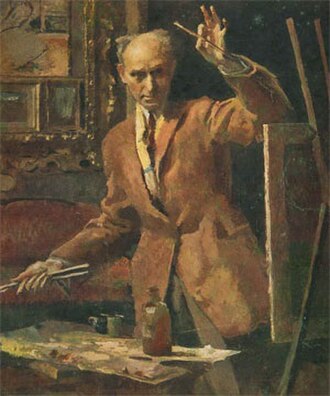
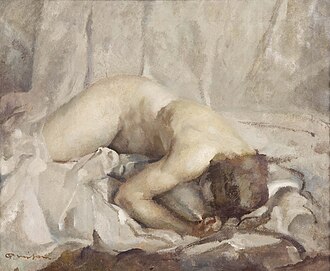
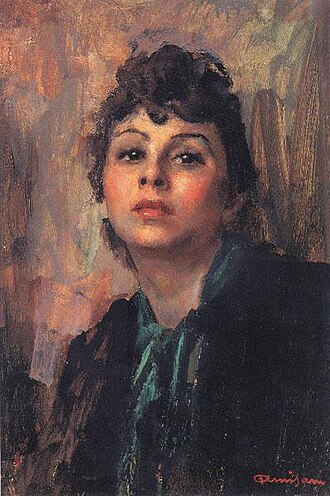
艺廊
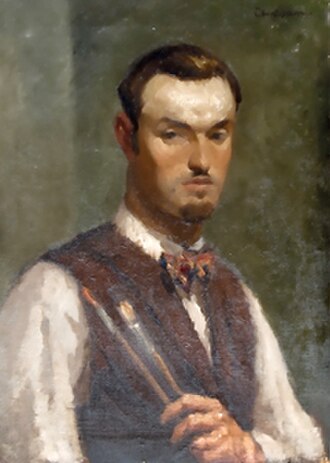
资料卡
- 出生
- 1881 年
- 出生地
- 梅代
- 去世
- 1941 年
- 逝世地
- 菲诺港
- 国籍
- 意大利王国
- 职业
- 画家、素描家
- 流派
- 新艺术运动、Art nouveau in Milan
- 老师
- 切萨雷·塔洛内、Emilio Gola、韦斯帕夏诺·比尼亚米
- 就读
- 布雷拉美术学院
- 获奖
- 米利乌斯奖
资料来自 Wikidata Q1877235(CC0)。
生平与创作
朱塞佩·阿米萨尼(意大利语:Giuseppe Amisani,1881年12月7日—1941年9月8日)是意大利美好年代时期的一位肖像画家。
生平
1881年12月7日,阿米萨尼在意大利北方的梅代出生。之后到家乡附近的帕维亚工学院念书,但在学期间工程制图一科不及格。后阿米萨尼进入米兰的布雷拉美术学院,师从切萨雷·塔洛内及韦斯帕夏诺·比尼亚米。1908年,他凭借《英雄》(意大利语:l'Eroe)赢得米利乌斯奖。1911年或1912年又凭借莉达·博雷利的肖像画赢得了富马加利奖。从此之后,阿米萨尼便将精力投入于肖像画的创作当中。
博物馆
米兰斯卡拉大剧院
布雷拉美术学院
佛罗伦萨乌菲兹美术馆
佛罗伦萨彼提宫
画展
From the Collection of the Uffizi Gallery,中国北京(2010)、长沙 (2011)
摘自维基百科「朱塞佩·阿米萨尼」,按 CC BY-SA 4.0 使用,繁体已转简体,去掉了参考文献、外部链接等尾部小节和表格,其余文字未作改动。
中文条目比较短,展开看英文维基百科的条目(英文原文)
Giuseppe Amisani (7 December 1881 – 8 September 1941) was an Italian portrait painter of the Belle Époque.
Life
Amisani was born on 7 December 1881 in Piazza Mercato (now Piazza Giuseppe Amisani) in the comune of Mede di Lomellina, near Pavia in Lombardy, northern Italy. He studied at the technical institute of Pavia, where he failed the technical drawing course; he then studied at the Accademia di Brera in Milan under Cesare Tallone and Vespasiano Bignami. He won the Mylius prize of the Academy for his painting l'Eroe ("the hero") in 1908, and in 1911 or 1912 won the Fumagalli prize for figure-painting with his portrait of Lyda Borelli. From then on he concentrated almost exclusively on portrait-painting; his landscapes of the Italian Alps, of Rhodes and of Tunisia also attracted interest.
Amisani was internationally famous in his time. He spent several years in Argentina and Brazil, and travelled also to England, France, North Africa and to the United States.
He died in Portofino on 8 September 1941.
Works
Many of Amisani's portraits are of women. Among them are La Teletta, in the Galleria d'Arte Moderna of Milan; his Ritratto di Lyda Borelli, in the São Paulo Museum of Art, Brazil; and Signora in grigio, his portrait of the actress Maria Melato, now in the Musei Civici di Monza.
Amisani exhibited at the twelfth Esposizione Internazionale d'Arte della Città di Venezia (later known as the Biennale di Venezia) in 1920.
In 1924, at the peak of his career, he was invited to Egypt to execute decorations at Ras al-Tin, the royal palace of Fuad I of Egypt. While there he painted a portrait of Farouk, then a small child. In 1926 Amisani was commissioned by the publishers of L'Illustrazione Italiana to paint landscapes in Rhodes. In the following year he exhibited North African landscapes in London.
A self-portrait was shown at the seventeenth Esposizione Internazionale d'Arte in Venice in 1930, and later bought by the Galleria degli Uffizi, Florence. Other works are in museums in Bari, Piacenza, and Lima, Peru.
Reception
Amisani was an important figure in his lifetime, though almost entirely forgotten today – his name is not included in the principal works of reference in the twenty-first century. He was a close contemporary of Umberto Boccioni and of Pablo Picasso, but completely ignored currents such as Futurism and Cubism which changed the face of fine art in the twentieth century, preferring to satisfy the tastes of his clients, who were the noble, rich and the famous of his time. His reputation was for elegance and for the fresh colours of his palette. A retrospective exhibition of his work at the Castello Sforzesco of Vigevano in the province of Pavia in 2008 was the first dedicated to him in fifty years.
Exhibitions
Exhibitions of Amisani's work have included:
Galleria Pesaro, Milan, 1923.
Egypt, Algiers and portraiture by Giuseppe Amisani, Arlington Gallery, Bond Street, London, 1927.
XVII Esposizione Internazionale d'Arte, Venice, 1930.
Giuseppe Amisani, Il pittore dei Re, Castello Sforzesco, Vigevano, Pavia, Italy, 2008.
Rirì la sciantosa e le altre. Ritratti di donne nella pittura di Giuseppe Amisani (1879–1941), Galleria Civica di Bari, 2012.
摘自英文维基百科「Giuseppe Amisani」,按 CC BY-SA 4.0 使用。
同时代的意大利王国画家
流派与收藏
作品(10)