艺廊
资料卡
- 出生
- 1575 年
- 出生地
- 阿拉尼亚瓦尔塞西亚
- 去世
- 1633 年
- 逝世地
- 韦尔切利省
- 职业
- 画家
- 代表作
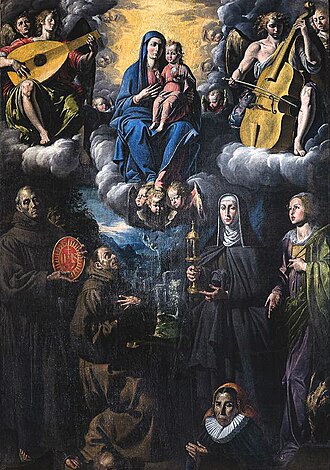
- Madonna and Child with St. Charles and St. Francis、Battle of Sennacherib、Davide e Golia
资料来自 Wikidata Q1056484(CC0)。
生平与创作
Antonio d'Enrico, called Tanzio da Varallo, or simply il Tanzio (c. 1575/1580 – c. 1632/1633) was an Italian painter of the late-Mannerist or early Baroque period. With Giovanni Battista Crespi, Giulio Cesare Procaccini and Pier Francesco Mazzucchelli, he was one of the principal Lombard painters of the early 17th century.
Biography
Early life, to 1625
Tanzio was born in Giacomolo hamlet, in Alagna Valsesia. His family had lived at Varallo since 1586, and he had two brothers who were also artists: the fresco painter Melchiorre d’Enrico, with whom he may have trained, and the sculptor and architect Giovanni d’Enrico (c. 1560–1644). On 12 February 1600 a safe conduct was issued to Melchiorre and Tanzio to leave Valsesia to visit Rome for the Holy Year. Tanzio’s first biographer, Cotta, wrote that the artist studied ‘in the Academies of Rome’ and that in 1627 ‘he left works, both of figures and landscapes, in Naples, in several places in Apulia, in Venice and in Vienna’. Though previously viewed with suspicion, recent discoveries have given some credence to this latter idea. Certainly early works of his have been discovered in what was then Apulia (now the Abruzzo): two altarpieces, the Circumcision (c. 1610; Fara San Martino, parish church) and the Miracle of the Quenched Fire (c. 1612; Pescocostanzo, Collegiata), and fragments of another that are now in the church of Santa Restituta in Naples. These show an early indebtedness to Caravaggio, and to the severity of Spanish Caravaggism. The Circumcision has clear iconographical similarities with a work of the same title by Orazio Gentileschi (c. 1605; Ancona, Chiesa del Gesù), suggesting that Tanzio was familiar with the work that Gentileschi did in the Marche c. 1616. The Miracle of the Quenched Fire, distinguished by the robust naturalism of the portrait of the patron, with an intensely spiritual St. Francis and radiantly beautiful angels, reverts to the more emotional style of the contemporary Milanese painters, Giulio Cesare Procaccini and Giovanni Battista Crespi, and was possibly painted after a brief return to the north. The fragments in Santa Restituta, Naples, suggest the influence of Orazio Borgianni and Antiveduto Grammatica.
It is not known exactly when Tanzio returned to Piedmont, but in 1611 an ‘Antonio, son of Giovanni d’Enrico’ is mentioned at Varallo. It is probable that the full-length portrait of Giovan Battista Caccia (priv. col.) attributed to Tanzio was painted in the Valsesia before 1613. The altarpiece in Domodossola Cathedral, St. Charles Borromeo Administering the Sacrament to Plague Victims, was Tanzio’s first major commission on his return. It must have been done before 27 August 1616, when it was mentioned in an account of an episcopal visit. The picture retains the archaizing quality of the Abruzzo altarpieces, but reveals a more intense naturalism in the powerful portrait heads of the bystanders and the almost trompe-l'œil effect of the butterfly in the foreground. This highly individual style of Caravaggism was not found elsewhere in Piedmont. Yet he also responded to Lombard Late Mannerism and to the art of Gaudenzio Ferrari. His brother Giovanni, who worked at the sacromonte of Varallo, where he created many terracotta statues in a Lombard populist style, also influenced his development. Probably from the same period as the Domodossala altarpiece are the Portrait of a Man and Portrait of a Woman (both Milan, Pinacoteca di Brera), St. Anthony (Varallo, Pinacoteca) and the St. Agatha (Milan, priv. col.).
Between 1616 and 1617, with his brother Giovanni, he decorated Chapel XXVII at the Sacro Monte di Varallo with frescoes and sculptures illustrating the theme of Christ before Pilate. Tanzio developed the popular realist style of his predecessor at Varallo, Gaudenzio Ferrari, creating vivid and immediate figures that move away from the more scenographic style of Morazzone’s frescoes in Chapels XXXIII and XXXVI and are in keeping with Giovanni’s statues. The background perspective view based on the ruined Torre delle Milizie in Rome recalls Tanzio’s period there. In 1618–20 the brothers again collaborated on the decoration of Chapel XXXIV with Pilate Washing his Hands. The vibrant chromatic tones of all these frescoes suggest the possible influence of Venetian art, perhaps of Paolo Veronese’s secular frescoes. There are many preparatory sketches for the sacromonte frescoes (Varallo, Pinacoteca), including a Flying Angel for the vault of Chapel XXVII. It is likely that his two pictures of David with the Head of Goliath (Varallo, Pinacoteca, nos 57 and 58) may be dated to this period. One of these (no. 58) recalls the young men in Christ before Pilate. The more celebrated work (no. 57) – a languid David holding up Goliath’s head in one hand and supporting his sword over his shoulder with the other – was probably slightly later.
After 1625
For Santa Cristina, Borgomanero, Tanzio painted the Virgin of the Rosary with St. Dominic and St. Catherine of Alexandria, which was in situ by 1626. There followed a group of more painterly works that include the Visitation (1627; Vagna, San Brizio) and St. Mark and St. Peter (Turin, Galleria Sabauda), the latter’s intensely moving atmosphere suggesting the deepening influence of Milanese painters, especially Cerano and Daniele Crespi. The most powerful of these works is the dramatic St. Charles Borromeo Carrying the Holy Nail in Procession (shortly after 1628; Cellio, parish church), dominated by the cadaverous figure of the saint, exhausted by asceticism. The fresco Christ before Herod, in Chapel XXVIII of the Sacro Monte, was completed by 1628.
In 1627–9 he decorated, in both fresco and oil, the chapel of the Guardian Angel in San Gaudenzio, Novara with scenes illustrating angelic intervention. This chapel is opposite the chapel of the Pia Mortis Sodalitas, frescoed by Morazzone in 1620, and the theatricality of Tanzio’s huge Battle of Sennacherib suggests Morazzone’s influence. This is Tanzio’s most dramatic and emotional work, its foreground crowded with distorted, brutally realistic figures, lit by violent slashes of light and shadowed by the vast expanse of darkness above.……
原文较长,这里只摘了前面一部分,摘自英文维基百科「Tanzio da Varallo」(暂时没有中文条目,下面是英文原文),按 CC BY-SA 4.0 使用,去掉了参考文献、外部链接等尾部小节和表格,其余文字未作改动。