 艺廊
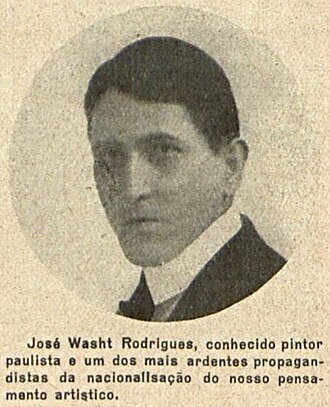
资料卡
- 出生
- 1891 年
- 出生地
- 圣保罗
- 去世
- 1957 年
- 逝世地
- 里约热内卢
- 国籍
- 巴西
- 职业
- 历史学家、画家
- 代表作
- coat of arms of São Paulo
- 就读
- 国立高等美术学院、朱利安艺术学校
资料来自 Wikidata Q10310660(CC0)。
生平与创作
José Wasth Rodrigues (19 March 1891 – 21 April 1957) was a Brazilian painter, drafter, illustrator, ceramist, teacher and historian. He was the uncle of the also illustrator Ivan Wasth Rodrigues.
Wasth Rodrigues was an important figure for the history of the city of São Paulo, being responsible for the development of several Brazilian municipalities' coats of arms, such as that of the City of São Paulo, of Mogi das Cruzes and of São Sebastião. Later, he would also design the coat of arms of the State of São Paulo. He also stands out for his work as a historian, leaving several publications focused on architectural documentation of civil and religious construction and works on antique furniture, clothing, insignias and military weapons.
José Wasth Rodrigues was a pioneer in showing concern about the demolitions and decharacterization suffered by examples of Brazil's cultural heritage, suggesting, in an inquiry for the newspaper "O Estado de São Paulo" about Colonial Architecture, that "the foundation of a Society or Commission of Architects with full powers with the governments and the Curias to embargo demolitions and prevent restorations from being made with the sacrifice of the building's 'characteristic physiognomy'".
Biography
José Wasth Rodrigues, born in São Paulo, studied for two years with Oscar Pereira da Silva. Not only a painter, he was also a historian and an expert in furniture, armory, and heraldry. He stood out, still young, in the production of plastic arts. In 1910, after his studies from 1908 to 1909, he received a trip to Europe from the government of the State of São Paulo.
In Paris, France, he attended the Académie Julian and the École des Beaux-Arts, having as masters Jean Paul Laurens, Nandi and Lucien Simon. In 1914, he exhibited at the Paris Salon, and before the outbreak of World War I, he returned to Brazil. Two years later (1916) he founded a drawing and painting course in São Paulo.
He returned to São Paulo in 1914, taking an active part in the city's artistic life. In 1916, together with George Fischer Elpons and William Zadig, he opens a painting and drawing course. Wasth Rodrigues creates many coats of arms, such as that of the city of São Paulo, in 1917, with the help of the poet Guilherme de Almeida (1890–1969), and also that of the State of São Paulo, in 1932.
He received his first gold medal at the Paulista Salon in 1933, and his first prize for painting in 1934. During his trips to Minas Gerais, Bahia, Pernambuco and Rio de Janeiro, he registered in oils, watercolors and drawings, mainly pen-and-ink, old manor houses, churches and monuments of the region. He gave important collaboration to the Department of National Historical and Artistic Heritage, participating in the advisory board and executing historical artistic works.
When recently arrived from a European season, Wasth Rodrigues, besides rendering services to Ricardo Severo's studies, also dedicated himself to illustrate Monteiro Lobato's books and articles from "Revista do Brasil". In his first phase (between 1916 and 1925), Wasth Rodrigues counted on the collaboration of the most important part of Brazilian intellectuality, for the defense and diffusion of nationalism, conquering a privileged space by the editorial quality and by the willingness to break with the superficiality that characterized the magazines born under the sign of the turn of the century. Born of articulations promoted by the owners of "O Estado de S. Paulo", the "Revista do Brasil", although of national repercussion, bore the mark of the São Paulo elites in its board of directors, formed by Júlio de Mesquita, Alfredo Pujol, and Luís Pereira Barreto; and, especially, in the list of 66 members of the anonymous society (presided over by Ricardo Severo) that made the project financially viable.
The question about the "national" was the order of the day, manifesting itself in all sectors of the country's intellectual life, and particularly in São Paulo. The European war had mortally wounded the spirit of the Belle Époque and, although reactions were not limited to the nativist search for Brazilian roots, for some time "modernity" and "nationalism" were almost synonymous. The Paulista strand of this movement manifested itself in interest in historical and folkloric themes from the past: bandeirantes, caipiras, genealogy, travelers' accounts.
Around 1918, Wasth Rodrigues began to dedicate himself to the study of colonial history, and became one of the pioneers in recording the artistic activities of the period. José Wasth Rodrigues was a pioneer in showing concern about the demolitions and decharacterization suffered by examples of the Brazilian cultural heritage. He suggested, then, in an inquiry for the newspaper "O Estado de S. Paulo" on Colonial Architecture, that "the foundation of a Society or Commission of Architects with full powers with the governments and the Curias to embargo demolitions and prevent restorations from being made with the sacrifice of the building's 'characteristic physiognomy'."
This interest in the architecture of the past, which extends to advocating preservation, is unusual in the period, and was not expressed even by Ricardo Severo, who never expressed any concern about it. Another important protagonist of the period who also seems to have been strongly impressed by Severo's ideas is Mário de Andrade, whose first articles on architecture – the series of articles under the title "A Arte religiosa no Brasil" (Religious Art in Brazil), published in 1920 in "Revista do Brasil" – as well as the travels he undertook to write them, seem clearly motivated by them. Like Wasth Rodrigues, Mário is certainly among the first artists and intellectuals of the period to get to know old Brazilian cities in loco. An excellent draftsman, he became famous for his works in quill pen, in which he addressed the urban landscape and detailed Brazilian colonial architecture and furniture.
José Wasth Rodrigues was responsible for reintroducing the tradition of tile painting in São Paulo's public artworks. He executed decorative panels for the four monuments of the Lorena Sidewalk and the old Santos road. In the capital of São Paulo, he decorated in tiles the Memory Square. As a painter, he stood out for his historical works, distinguished by the capriciousness in portraying the details of the events portrayed.
原文较长,这里只摘了前面一部分,摘自英文维基百科「José Wasth Rodrigues」(暂时没有中文条目,下面是英文原文),按 CC BY-SA 4.0 使用,去掉了参考文献、外部链接等尾部小节和表格,其余文字未作改动。
师承与影响
同时代的巴西画家
流派与收藏
作品(26)
只有资料的作品(26)
- João Ramalho e Filho1934 年
- Várzea do Carmo e Rio Tamanduateí, 18581922 年
- Cacique Tibiriçá e neto1932 年
- Dama Paulista, 1808
- Páteo e Igreja da Sé e São Pedro, 1840
- Rua Direita e Largo São Pedro no Páteo da Sé, 18581922 年
- Soldado da Legião Paulista na Cisplatina e Gaúcho
- Aspecto da Rua do Rosário à noite em 1862
- Passarola de Bartolomeu de Gusmão20 世纪
- Casas Velhas de Santos, 18261922 年
- Rua da Glória e Largo de São Paulo
- Trecho final da antiga Rua do Rosário, 18581919 年
- Igreja de Santo Antonio, 1826
- Batalha de Ituzaingó1939 年
- Rua do Rosário, 18581920 年
- Páteo da Igreja de São Francisco, 1862
- Igreja do Largo Santa Ifigênia, 18641918 年
- Monumento a Bartolomeu de Gusmão (Face Principal)
- Paço Municipal, 16281920 年
- Paulistas Antigos, 1825
- Rua São Bento, 1858
- Retrato de Martim Afonso de Sousa20 世纪
- Igreja e Páteo da Misericórdia1922 年
- Pateo do Colégio, 18581918 年
- Rua Direita, 1860
- Passarola